# AI Agents vs Chatbots: A Simple Guide For 2026
You need to pick the right AI for your business. But AI agents vs chatbots confuses most owners. Both tools promise better service. Yet they work in completely different ways.
This guide clears up the confusion fast. You’ll learn what AI agents and chatbots actually do. You’ll see when each tool makes sense. And you’ll discover which one fits your business best.
I built a million-dollar agency using these exact AI systems. My clients generated over $25M in revenue with smart automation. Now I’ll show you how to choose the right AI tool for your needs.
Table of Contents
- What Are Chatbots and How They Work
- What Are AI Agents and Their Capabilities
- Key Differences Between AI Agents vs Chatbots
- When to Use Chatbots vs AI Agents
- How to Implement AI in Your Business
- The Future of AI Agents and Chatbots
What Are Chatbots and How They Work
Chatbots answer questions using pre-programmed responses. They follow decision trees built by developers. A customer asks a question. The chatbot matches keywords. Then it delivers a scripted answer.
Most chatbots work great for simple tasks. They handle FAQs efficiently. They schedule basic appointments. They collect contact information. But they struggle with complex requests.
How Traditional Chatbots Operate
Traditional chatbots use rule-based logic. Developers create “if-then” statements. If a user types “hours,” then show business hours. This approach works for predictable conversations.
The system matches user input to keywords. It searches a database of responses. Then it delivers the closest match. No real understanding happens here.
These chatbots can’t learn from conversations. They repeat the same responses endlessly. Updates require manual programming. Your team must add new responses manually.
Modern Chatbot Capabilities
Modern chatbots use natural language processing. They understand intent better than old versions. They can handle more variations of questions. But they still follow predetermined paths.
These upgraded chatbots integrate with business systems. They check inventory. They pull order status. They access customer records. This makes them more useful than basic versions.
However, chatbots still have clear limits. They can’t make judgment calls. They can’t adapt to unique situations. They fail when conversations go off-script.
Common Chatbot Use Cases
Chatbots excel at repetitive customer service tasks. They answer the same questions thousands of times. They never get tired or frustrated. They work 24/7 without breaks.
Many businesses use chatbots for lead capture. The bot asks qualifying questions. It collects contact details. Then it routes leads to sales teams.
E-commerce sites deploy chatbots for order tracking. Customers ask about shipping. The bot pulls real-time data. It provides instant updates. This reduces support tickets significantly.
Key Takeaway: Chatbots handle simple, repetitive tasks efficiently but struggle with complex requests.
What Are AI Agents and Their Capabilities
AI agents think and act more like humans. They analyze situations. They make decisions. They complete multi-step tasks without constant supervision.
These autonomous agents vs chatbots show clear differences. An AI agent doesn’t just respond. It takes action. It solves problems independently.
What Makes AI Agents Different
AI agents use advanced machine learning models. They understand context deeply. They remember past interactions. They learn from every conversation.
These systems can break down complex goals. They create step-by-step plans. Then they execute those plans autonomously. No human intervention needed for routine tasks.
AI agents adapt to new situations. They don’t need reprogramming for every scenario. They generalize knowledge across different contexts. This flexibility transforms business operations.
Modern AI agents for business integrate with multiple systems. They pull data from various sources. They make informed decisions based on complete information.
Core Capabilities of AI Agents
AI agents can understand nuanced requests. A customer might say “I need something like what I ordered last time but cheaper.” The agent analyzes purchase history. It considers budget constraints. It recommends suitable alternatives.
These agents handle multi-step workflows automatically. Book a meeting. Send confirmation. Add to calendar. Create prep documents. All without human involvement.
AI agents learn from outcomes continuously. They track what works. They adjust strategies based on results. Performance improves over time automatically.
They also handle exceptions gracefully. When something unexpected happens, they evaluate options. They choose the best response. Or they escalate to humans when needed.
Real-World AI Agent Applications
Sales teams use AI agents for prospecting. The agent researches potential clients. It crafts personalized outreach messages. It schedules follow-ups based on responses.
Customer service departments deploy AI agents for complex issues. The agent diagnoses problems. It tries multiple solutions. It learns which approaches work best.
Marketing teams leverage AI agents for campaign optimization. The agent tests different messages. It analyzes performance data. It shifts budget to winning strategies automatically.
According to research on AI transformation in business operations, companies using autonomous agents see 40% faster problem resolution. They complete tasks with 60% less manual intervention.
Key Takeaway: AI agents solve complex problems independently and learn from every interaction.
Key Differences Between AI Agents vs Chatbots
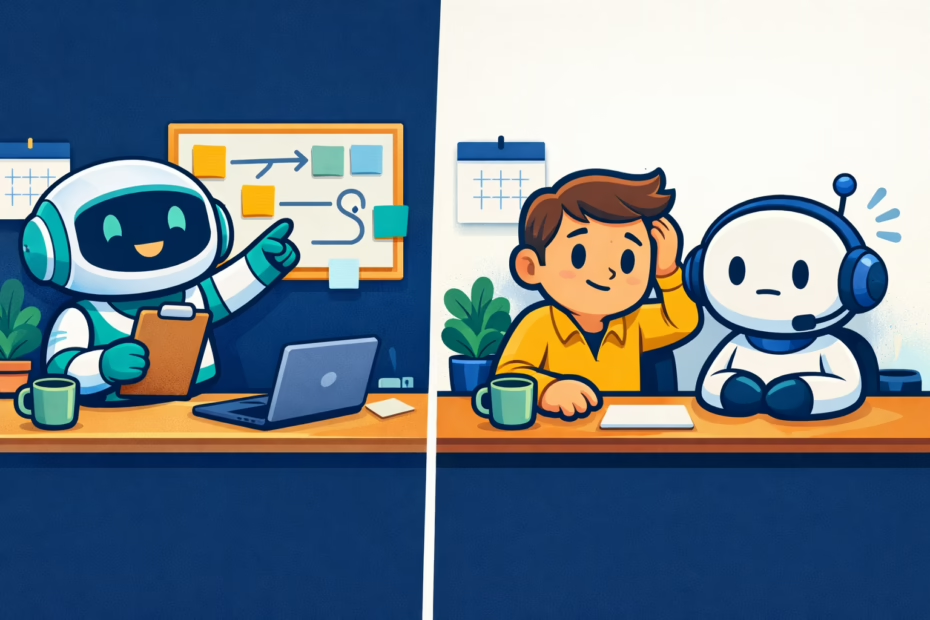
The chatbot vs AI agent debate comes down to capability. Chatbots respond. AI agents act. This distinction matters for your business results.
Autonomy and Decision-Making
Chatbots wait for user input. They react to questions. They can’t initiate actions independently. An AI agent can start tasks on its own.
For example, a chatbot answers “What are your hours?” An AI agent notices a customer browsing late. It offers scheduling assistance proactively. It anticipates needs.
AI agents make decisions without human approval. They evaluate multiple options. They weigh trade-offs. They choose the best path forward.
Chatbots require explicit instructions for everything. AI agents infer goals from context. They fill in gaps themselves. This autonomy saves massive time.
Learning and Adaptation
Chatbots stay static until someone updates them. Their knowledge freezes at deployment. New scenarios break them.
AI agents improve through experience. Each conversation adds to their knowledge. They identify patterns humans miss. They refine responses automatically.
This conversational AI comparison highlights a crucial point. Chatbots deliver consistency. AI agents deliver continuous improvement. Choose based on your priority.
AI agents also transfer learning across domains. Lessons from customer service improve sales interactions. Knowledge compounds rapidly.
Task Complexity
Chatbots handle single-step interactions well. “What’s my balance?” leads to one database query. Simple and efficient.
AI agents manage multi-step workflows. “Help me reduce costs” triggers analysis. The agent reviews spending patterns. It identifies savings opportunities. It implements changes. It monitors results.
Complex problem-solving separates these technologies completely. Chatbots escalate complicated issues to humans. AI agents solve them independently most of the time.
The AI tools you choose determine your team’s efficiency. AI agents multiply your workforce capacity. Chatbots simply answer more questions faster.
Integration and Workflow
Chatbots typically connect to one or two systems. They pull limited data. They perform basic lookups. Integration stays shallow.
AI agents orchestrate entire business processes. They access CRM systems. They update project management tools. They trigger marketing automation. They coordinate across platforms.
This deep integration enables true automation. An AI agent can qualify a lead. Add them to your CRM. Schedule a sales call. Send prep materials. Update forecasts. All from one interaction.
Studies from Entrepreneur on AI customer service show businesses using AI agents reduce response times by 70%. They also increase customer satisfaction scores by 45%.
Key Takeaway: AI agents handle complexity, learn continuously, and coordinate multiple systems autonomously.
When to Use Chatbots vs AI Agents
Choosing between AI agents vs chatbots depends on your specific needs. Both tools serve important purposes. The right choice multiplies your results.
Best Scenarios for Chatbots
Use chatbots when questions are predictable. FAQs change rarely. Answers stay consistent. Chatbots excel here.
Deploy chatbots for simple qualification flows. “What service interests you?” “What’s your budget?” “What’s your timeline?” These structured paths work perfectly.
Chatbots make sense for basic information delivery. Store hours. Return policies. Shipping costs. This information doesn’t require intelligence. It needs quick access.
Small businesses with limited budgets benefit from chatbots first. They cost less to implement. They deliver immediate value. They handle the majority of basic inquiries.
Chatbots also work well for appointment booking. The process follows clear rules. Available times. Customer preferences. Confirmation. No judgment needed.
Ideal Use Cases for AI Agents
Choose AI agents when customer needs vary widely. Each situation requires unique handling. Context matters tremendously.
AI agents shine in complex sales environments. They understand product fit. They recommend solutions. They handle objections intelligently. They close deals autonomously.
Use AI agents for technical support. Problems don’t follow scripts. Diagnosis requires reasoning. Solutions need adaptation. AI agents excel at troubleshooting.
Businesses scaling rapidly need AI agents. Your team can’t keep up manually. Standard chatbots break under complexity. AI agents scale with your growth.
AI agents also handle strategic tasks. Market research. Competitor analysis. Content creation. These require understanding and creativity.
Hybrid Approaches
Many successful businesses use both technologies. Chatbots handle simple queries. AI agents manage complex interactions. This combination optimizes costs.
Start conversations with a chatbot. It gathers basic information. When complexity increases, hand off to an AI agent. This tiered approach works beautifully.
The chatbot acts as a filter. It resolves 70% of inquiries instantly. The AI agent focuses on the 30% needing intelligence. Your human team handles only exceptions.
This hybrid model delivers the best ROI. You pay less for simple interactions. You invest in AI power where it matters most.
Key Takeaway: Use chatbots for predictable tasks and AI agents for complex problem-solving.
How to Implement AI in Your Business
Implementation determines success with AI agents vs chatbots. Follow these steps to get results fast. Skip steps and you’ll waste money.
Step 1: Audit Your Customer Interactions
Review your most common customer questions. Categorize them by complexity. Simple questions go to chatbots. Complex issues need AI agents.
Track how much time your team spends on each type. Calculate the cost of manual handling. This data justifies your AI investment clearly.
Step 2: Define Clear Objectives
Set specific goals for your AI implementation. “Reduce response time by 50%” works. “Improve customer satisfaction” stays too vague.
Identify which processes to automate first. Start with high-volume, low-complexity tasks. Quick wins build momentum and prove value.
Step 3: Choose the Right Platform
Evaluate platforms based on your needs. Some excel at chatbots. Others specialize in AI agents. Few do both well.
Look for platforms with proven business results. The AI business coach approach combines tools with strategy. Technology alone won’t transform your business.
Step 4: Start with a Pilot Program
Launch your AI system with one use case. Test it thoroughly. Gather feedback from customers and team members.
Monitor performance metrics closely. Response accuracy. Resolution time. Customer satisfaction. Let data guide improvements.
Step 5: Train Your Team
Your team must understand how AI works. They need to know when to intervene. They should monitor AI performance actively.
Create clear escalation paths. Define when AI hands off to humans. Set response time expectations for human follow-up.
Step 6: Integrate with Existing Systems
Connect your AI to your CRM. Link it to your help desk. Integrate with inventory management. Data silos kill AI effectiveness.
The more systems your AI accesses, the smarter it becomes. Complete information enables better decisions consistently.
Step 7: Establish Feedback Loops
Create systems to capture AI mistakes. Log customer frustration. Track unresolved issues. Feed this back to improve performance.
Review AI conversations regularly. Identify patterns in failures. Use insights to refine responses and capabilities.
Step 8: Scale Gradually
After your pilot succeeds, expand slowly. Add one use case at a time. Ensure quality before increasing volume.
As confidence grows, increase AI authority. Let it handle more decisions independently. Monitor results at every stage.
Step 9: Measure ROI Continuously
Track cost savings from automation. Calculate time reclaimed by your team. Measure improvements in customer satisfaction.
Compare these benefits to implementation costs. Adjust your strategy based on real numbers. Double down on what works.
Step 10: Keep Humans in the Loop
AI augments your team, not replaces them. Complex decisions still need human judgment. Emotional situations require human touch.
Design your AI system with clear human oversight. Regular check-ins catch problems early. This balance maximizes results.
Research on SBA business management best practices emphasizes gradual technology adoption. Businesses that implement AI incrementally see 3x higher success rates.
Key Takeaway: Successful AI implementation requires clear goals, gradual scaling, and continuous measurement.
The Future of AI Agents and Chatbots
The AI landscape evolves rapidly. Understanding future trends helps you stay ahead. Early adopters gain massive competitive advantages.
Convergence of Technologies
The line between chatbots and AI agents blurs. Modern chatbots add AI capabilities. Basic AI agents become more affordable. This convergence benefits small businesses most.
Soon, most customer interactions will involve some AI. The question shifts from “should we use AI?” to “how much autonomy should we give it?”
Increased Personalization
Future AI agents will know customers deeply. They’ll remember preferences across years. They’ll anticipate needs before customers ask.
This personalization drives loyalty and revenue. Customers feel understood. They receive relevant recommendations. They buy more often.
Multi-Modal Interactions
AI agents will communicate through multiple channels. Text, voice, video, and images. They’ll choose the best format automatically.
A customer might start a text conversation. The AI agent might send a video tutorial. Then follow up with a voice call. All seamlessly integrated.
Proactive AI Engagement
Future AI won’t wait for customer contact. It will reach out proactively. “I noticed you haven’t ordered in a month. Here’s a special offer.”
This shift from reactive to proactive transforms customer relationships. AI becomes a trusted advisor, not just a support tool.
Emotional Intelligence
Next-generation AI agents will read emotional cues. They’ll detect frustration in text. They’ll adjust tone and approach accordingly.
This emotional intelligence makes AI interactions feel more human. Customers forget they’re talking to machines.
Industry-Specific AI Agents
Generic AI gives way to specialized agents. Healthcare AI understands medical context. Legal AI knows case law. Financial AI grasps investment strategies.
These specialized agents deliver far better results. They understand industry nuances. They provide expert-level guidance.
Regulatory Frameworks
Governments worldwide develop AI regulations. Transparency requirements increase. Privacy protections strengthen. Businesses must adapt quickly.
Staying compliant becomes a competitive advantage. Customers trust regulated AI more. They share data more freely.
Cost Reduction
AI implementation costs drop dramatically. Cloud platforms democratize access. Small businesses afford enterprise-level AI. This levels the playing field.
The businesses that act now build advantages. They gain experience while competitors wait. They optimize systems before others start.
Key Takeaway: AI agents and chatbots will become more intelligent, personalized, and proactive.
Quick Reference: AI Agents vs Chatbots Defined
Chatbot: A software program that uses pre-programmed responses or basic natural language processing to answer questions and complete simple tasks through text-based conversation. Chatbots follow decision trees and rules set by developers.
AI Agent: An autonomous software system that uses advanced machine learning to understand context, make decisions, complete multi-step tasks, and learn from interactions without constant human supervision. AI agents adapt to new situations and solve complex problems independently.
Key Distinction: Chatbots respond to inputs following pre-set rules. AI agents analyze situations, make independent decisions, and take action autonomously. Chatbots handle simple, predictable tasks. AI agents manage complex, variable workflows.
Conclusion: Making the Right Choice for Your Business
AI agents vs chatbots represents more than technology selection. It determines how you scale your business. The right choice multiplies your team’s impact.
Chatbots deliver immediate value for simple tasks. They answer common questions. They qualify basic leads. They reduce support tickets. Start here if you’re new to AI.
AI agents transform complex operations. They handle nuanced customer needs. They coordinate multiple systems. They improve continuously. Invest here when you’re ready to scale.
Most successful businesses use both. Chatbots filter simple requests. AI agents solve complex problems. This combination optimizes costs while maximizing results.
The future belongs to businesses that embrace AI now. Early adopters build competitive moats. They serve customers better. They operate more efficiently. They grow faster.
Don’t let technology intimidate you. Start small. Test one use case. Measure results. Then expand based on success. This approach minimizes risk while maximizing learning.
Your competitors already explore these tools. The question isn’t whether to adopt AI. It’s when and how. The answer is now, starting with clear goals and gradual implementation.
Your Next Steps
First, audit your current customer interactions today. Identify repetitive questions. Find complex problems consuming team time. This audit reveals your opportunities.
Second, set one clear goal for AI. Reduce response time. Increase lead qualification. Improve customer satisfaction. Focus creates momentum.
Third, explore platforms that match your needs. Look for proven results in your industry. Prioritize ease of implementation. Value support and training.
The AI automation tools at Uplify combine chatbots and AI agents. They integrate with your existing systems. They deliver measurable results fast.
Don’t wait for perfect conditions. Start learning now. Every conversation improves your AI. Every improvement increases your competitive advantage.
Your business deserves the best tools. Your customers expect fast, intelligent service. AI makes both possible. Take the first step today.
Frequently Asked Questions
What is the main difference between AI agents vs chatbots?
Chatbots respond to questions using pre-programmed answers. They follow decision trees. AI agents think independently. They analyze situations. They make decisions. They complete complex tasks autonomously. Chatbots need explicit programming for every scenario. AI agents learn and adapt continuously.
How do I know if my business needs a chatbot or AI agent?
Choose chatbots for simple, repetitive questions. Use them for FAQs and basic scheduling. Pick AI agents for complex customer needs. Deploy them when situations vary widely. AI agents excel at problem-solving and multi-step workflows. Start with chatbots if you’re new to AI.
Can AI agents replace my customer service team?
No, AI agents augment teams, not replace them. They handle routine tasks automatically. This frees your team for complex issues. Emotional situations still need human touch. Strategic decisions require human judgment. AI agents multiply your team’s capacity effectively.
What’s the cost difference between chatbots and AI agents?
Chatbots typically cost less initially. Implementation runs $500-$5,000 for basic systems. AI agents require larger investments. They range from $5,000-$50,000 depending on complexity. However, AI agents deliver higher ROI long-term. They handle more valuable tasks independently.
How long does it take to implement AI agents or chatbots?
Simple chatbots launch in 1-2 weeks. Complex chatbots need 1-3 months. AI agents require 2-6 months for full implementation. Start with a pilot program first. Test one use case thoroughly. Then scale based on proven results. Gradual implementation reduces risk significantly.

Kateryna Quinn is the founder and CEO of Uplify AI, an AI-powered business strategist that helps service-based, brick-and-mortar small business owners increase profitability and reclaim their time. She also founded ASTASH, an award-winning full-service digital marketing agency specializing in SEO, Google Ads, branding, logo design, and website development, based in Northern Colorado. A Ukrainian immigrant who came to the United States at 17, Quinn has generated more than $25 million in organic revenue for her agency clients. She is a Forbes NEXT 1000 honoree and was named to NOCO Style Magazine’s 30 Under 30.