AI agents promise to automate your business. But they have real limits you need to know. These gaps can cost you time and money.
This guide shows you what AI agents can’t do. You’ll learn where they fail. And you’ll see how to work around their weaknesses.
I built Uplify after generating $25M for clients. I’ve tested AI agents in real businesses. Here’s what actually works in 2026.
Table of Contents
- What Are AI Agent Limitations?
- Common AI Agent Weaknesses in Business
- Where Autonomous Agents Fail Most
- Human Skills AI Can’t Replace
- Working Around AI Gaps
- The Future of AI Limitations
What Are AI Agent Limitations?
AI agent limitations are the tasks and decisions AI can’t handle well. Every AI system has boundaries. Understanding these limits helps you use AI better.
Most AI agents struggle with context. They miss nuance in conversations. They can’t read emotion like humans can.
AI agents also lack true judgment. They follow patterns from training data. But they can’t think outside those patterns.
The Core Weaknesses of AI Agents
AI agents can’t understand true intent. They process words, not meaning. This creates communication gaps in business settings.
They also lack common sense. An AI might suggest a solution that’s technically correct. But it makes no sense in real life.
Memory is another limit. AI agents forget context between sessions. They don’t build relationships like human team members do.
Key Point: AI agents work best with clear, structured tasks. Complex decisions still need human oversight.
Why These Limits Matter in 2026
Small business owners often expect too much from AI. They think it will solve everything. Then they feel disappointed when it doesn’t.
Understanding AI limitations saves you time. You’ll know which tasks to automate. And which ones need your personal touch.
The SBA guidance on business operations emphasizes human judgment in critical decisions. AI supports these decisions but can’t replace them.
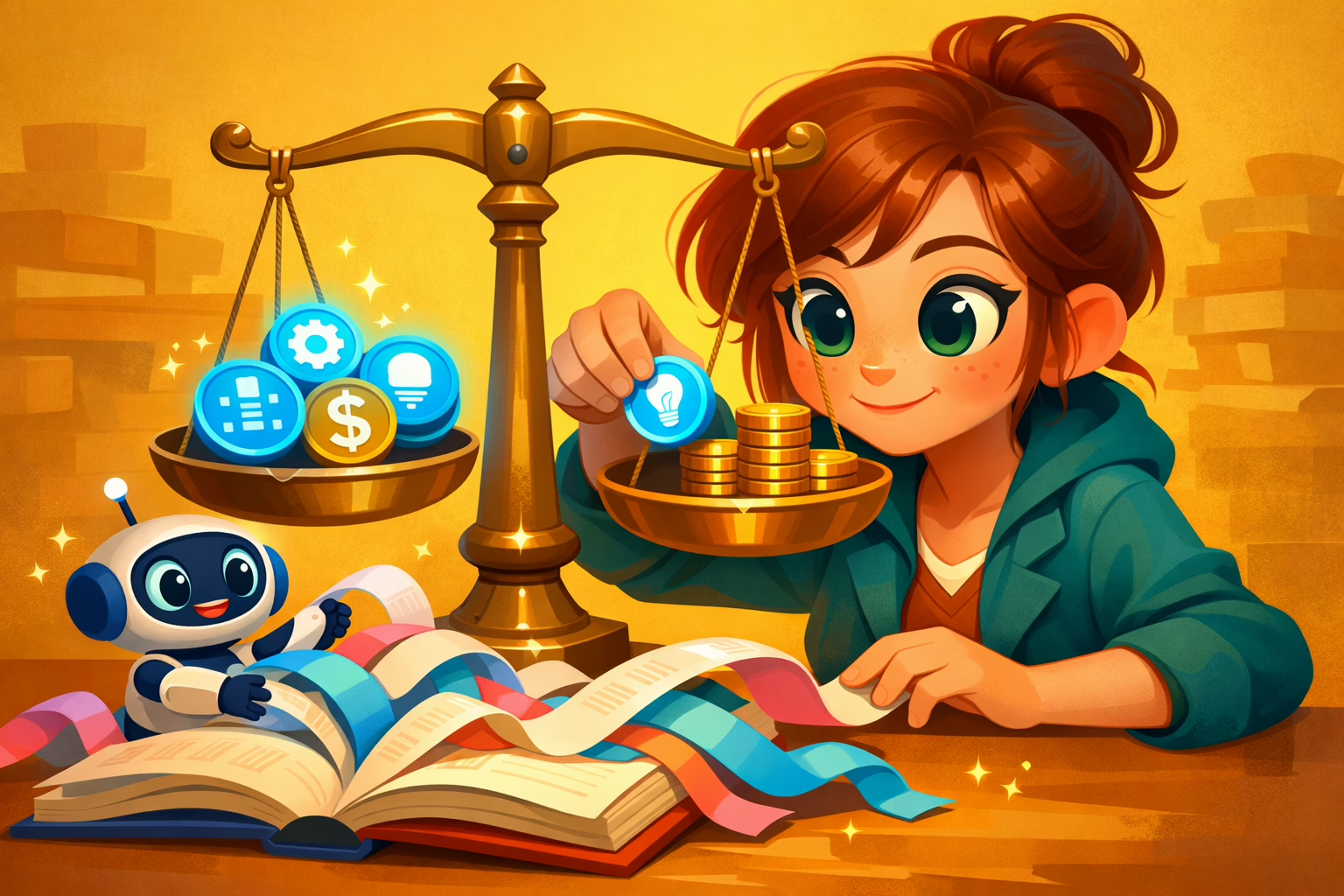
Smart business owners use AI for speed. But they keep humans in the loop. This hybrid approach delivers the best results.
Expert Insight from Kateryna Quinn, Forbes Next 1000:
“I tested dozens of AI agents in my agency. The winners knew their limits. They enhanced human work instead of replacing it.”
Common AI Agent Weaknesses in Business
AI agents fail at understanding customer emotions. They miss subtle cues in conversations. This creates awkward interactions that damage trust.
They also struggle with creative problem-solving. AI can optimize existing processes well. But it can’t invent entirely new solutions.
Customer Service Gaps
AI chatbots often frustrate customers. They can’t handle complex complaints. They repeat the same unhelpful responses.
When emotions run high, AI agents fail completely. They can’t de-escalate angry customers. They lack empathy and flexibility.
Many customers want human connection. Research on business fundamentals shows customer service remains critical. AI tools work best for simple queries only.
Your business needs humans for relationship building. AI can handle routine questions. But complex issues require human touch.
Sales and Persuasion Limits
AI agents can’t read a room. They miss buying signals in conversations. They can’t adjust pitch based on body language.
They also lack genuine enthusiasm. Customers sense when they’re talking to a bot. This reduces conversion rates for big purchases.
The best sales reps build trust over time. They remember personal details. They follow up with authentic care. AI can’t replicate this yet.
Use AI for lead qualification and scheduling. But keep humans involved in closing deals. This hybrid approach maximizes your AI agent capabilities while maintaining personal connection.
Strategic Decision-Making Weaknesses
AI agents can’t see the big picture. They analyze data well. But they miss context that humans understand instinctively.
They also lack business intuition. Sometimes the data says one thing. But experience tells you something different. AI can’t navigate this.
Long-term planning needs human vision. AI can forecast based on trends. But it can’t imagine entirely new market opportunities.
Key Insight: Use AI for data analysis and pattern recognition. Keep humans in charge of strategy and vision.
Where Autonomous Agents Fail Most
Autonomous AI agents make mistakes with ambiguous instructions. They need clear, specific directions. Vague requests produce unreliable results.
They also fail when circumstances change unexpectedly. AI follows programmed rules. It can’t adapt to sudden market shifts.
Context Switching Problems
AI agents struggle when tasks overlap. They can’t juggle multiple priorities well. They lose track of connections between projects.
Human workers understand how tasks relate. They adjust priorities naturally. AI needs explicit instructions for every scenario.
This limitation matters in fast-paced businesses. When emergencies arise, AI can’t reprioritize automatically. You need humans to make judgment calls.
Quality Control Issues
AI agents can’t judge quality like humans. They follow metrics you provide. But they miss subjective quality factors.
A piece of content might check all boxes. But it still feels off to human readers. AI can’t detect this disconnect.
The U.S. Chamber’s business trend analysis shows quality remains a top concern. AI tools need human oversight for quality assurance.
Set up regular quality checks. Review AI output before it reaches customers. This prevents embarrassing mistakes.
Ethical and Legal Boundaries
AI agents don’t understand ethics naturally. They can suggest solutions that violate regulations. They miss nuanced legal implications.
They also can’t handle gray areas. Business often involves ethical dilemmas. AI needs black-and-white rules to function.
Always have humans review AI recommendations. Especially in legal, financial, or sensitive areas. The risk isn’t worth the automation.
Your profit optimization should never compromise ethics. Use AI to enhance human judgment, not replace it.
Real Talk from Kateryna:
“I’ve seen businesses burned by autonomous AI. They let it run without oversight. One bad decision cost them a major client.”
Human Skills AI Can’t Replace
Emotional intelligence remains uniquely human. AI can’t truly understand feelings. It processes words but misses deeper meaning.
Building genuine relationships takes human connection. Customers remember how you made them feel. AI interactions feel transactional.
Creative and Strategic Thinking
True creativity requires breaking patterns. AI improves existing ideas. But it can’t imagine completely new concepts.
Strategic thinking involves vision and intuition. You see opportunities AI misses. You understand market dynamics deeply.
The best business leaders combine data with instinct. They use AI for analysis. But they make final decisions based on experience.
Relationship Building and Trust
Long-term client relationships need human touch. People buy from people they trust. AI can’t build this trust authentically.
Networking requires reading social cues. You adjust your approach in real time. AI can’t navigate complex social dynamics.
Remember: business success comes from relationships. Use AI to support these relationships. But keep humans at the center.
Complex Problem-Solving
Some problems need creative solutions. AI suggests answers based on past data. But novel challenges require human innovation.
You can connect seemingly unrelated ideas. AI works within defined parameters. This limits its problem-solving ability.
According to revenue growth strategies, innovation drives profit. AI helps execute ideas but can’t create breakthrough concepts.
Use AI for routine problems. Bring humans in for complex challenges. This division of labor maximizes both.
Bottom Line: AI enhances human capabilities. It doesn’t replace them. The best results come from human-AI collaboration.
Working Around AI Gaps
Set clear boundaries for your AI agents. Define exactly what they can handle. Keep humans responsible for everything else.
Create approval workflows for AI decisions. Review outputs before they go live. This catches errors before customers see them.
Hybrid Workflow Design
Build systems that combine AI and human strengths. Let AI handle repetitive tasks. Keep humans focused on high-value work.
For example, AI can draft initial responses. Then humans personalize and refine them. This saves time while maintaining quality.
The workflow should feel natural. AI does the heavy lifting. Humans add the finishing touches.
Regular Monitoring and Adjustment
Check AI performance weekly. Look for patterns in mistakes. Adjust your prompts and settings regularly.
AI agents need ongoing training. As your business evolves, update their instructions. This keeps them aligned with your goals.
Track metrics that matter. Measure AI accuracy and customer satisfaction. Use this data to improve your systems.
Many business owners use AI tools for business tasks but forget to monitor results. Regular review prevents small problems from becoming big ones.
Building Safety Nets
Create backup plans for when AI fails. Have humans ready to step in. This prevents service disruptions.
Set up alerts for unusual AI behavior. Get notified when outputs seem off. Quick intervention prevents customer issues.
Test AI systems before full deployment. Run pilot programs with limited risk. Learn from small failures, not big ones.
Pro Tip: Never let AI make irreversible decisions. Always include a human checkpoint for important actions.
Training Your Team
Teach your team about AI limitations. They need to know when to override AI. This prevents blind trust in automation.
Provide clear guidelines for AI use. What tasks should they automate? What requires human judgment? Remove any confusion.
Encourage feedback from your team. They’ll spot AI problems you miss. Their insights improve your systems over time.
Kateryna’s Advice:
“Train your team to think critically about AI outputs. The best teams question AI recommendations. They don’t accept them blindly.”
The Future of AI Limitations
AI capabilities improve constantly. Today’s limitations may disappear tomorrow. But new challenges will emerge too.
The gap between AI and human intelligence shrinks. But true understanding remains elusive. AI processes information, not meaning.
What’s Improving in AI Agents
Context retention is getting better. Newer AI agents remember longer conversations. They maintain continuity across interactions.
Multi-modal understanding is advancing. AI now processes text, images, and audio together. This creates more natural interactions.
Personalization capabilities grow stronger. AI learns your preferences over time. It adapts to your communication style.
What Will Stay Limited
True creativity remains human territory. AI will enhance creative work. But original vision comes from people.
Ethical judgment needs human values. AI can follow rules. But it can’t navigate moral gray areas.
Emotional connection stays uniquely human. Customers want genuine empathy. AI can simulate it but not feel it.
Preparing for 2026 and Beyond
Stay updated on AI developments. New capabilities emerge monthly. Early adopters gain competitive advantages.
But don’t chase every new tool. Focus on AI that solves real problems. Avoid technology for technology’s sake.
Build flexible systems. Design workflows that adapt to new AI capabilities. This future-proofs your business operations.
The best approach combines current AI with future readiness. Use today’s tools effectively. But stay prepared for tomorrow’s advances.
Looking Ahead: AI limitations will shift, not disappear. Smart business owners adapt continuously. They use AI strategically, not blindly.
Step-by-Step Process: Implementing AI with Known Limitations
Here’s how to use AI agents effectively while respecting their boundaries:
- Audit Current Tasks: List all business tasks. Mark which ones are repetitive and rule-based.
- Identify AI Candidates: Choose tasks with clear inputs and outputs. Avoid ambiguous or creative work.
- Set Clear Boundaries: Define exactly what AI can decide. Mark everything else for human review.
- Create Approval Workflows: Build checkpoints where humans verify AI output. Never skip this step.
- Start Small: Test AI on low-risk tasks first. Learn from safe experiments before scaling.
- Monitor Results Daily: Track AI performance closely at first. Look for patterns in errors.
- Gather Team Feedback: Ask your team about AI effectiveness. They’ll spot issues you miss.
- Adjust and Refine: Update AI instructions based on results. Continuous improvement matters most.
- Document Everything: Write down what works and what doesn’t. Build institutional knowledge.
- Scale Gradually: Expand AI use only after proving success. Slow growth beats fast failure.
Quick Reference: AI Agent Limitations Defined
AI agent limitations refer to the specific tasks, decisions, and contexts where artificial intelligence agents cannot perform as well as humans. These include understanding emotional nuance, making ethical judgments, adapting to unexpected situations, building genuine relationships, and solving novel problems that require creative thinking. While AI excels at pattern recognition and repetitive tasks, it struggles with ambiguity, context switching, and situations requiring human intuition or empathy.
Frequently Asked Questions
What is AI agent limitations?
AI agent limitations are the boundaries of what artificial intelligence can do. These include understanding emotions, making creative decisions, and building real relationships. AI agents work best on structured tasks with clear rules. They struggle with ambiguity and context.
How do AI agent weaknesses affect my business?
AI weaknesses can create customer service problems. They may frustrate clients with robotic responses. They can also make poor strategic decisions without human oversight. Smart businesses use AI for speed but keep humans for judgment.
Why can’t autonomous agents replace human workers?
Autonomous agents lack true understanding and empathy. They can’t build genuine relationships or make creative leaps. They miss emotional cues that humans catch naturally. Business success requires human connection that AI can’t replicate yet.
When should I avoid using AI agents?
Avoid AI for complex customer complaints and sensitive conversations. Don’t use it for strategic planning or ethical decisions. Skip AI when creativity and genuine empathy matter most. Keep humans in charge of relationship building and trust.
Can AI gaps be fixed with better training?
Some AI gaps narrow with better training and data. But fundamental limitations remain. AI can’t develop true understanding or consciousness. Training improves performance within existing boundaries. It doesn’t create human-like judgment or creativity.
Conclusion: Using AI Wisely in Your Business
AI agent limitations are real. But they don’t make AI useless. They just define where AI works best.
Smart business owners embrace hybrid approaches. They use AI for speed and efficiency. They keep humans for judgment and relationships.
The key is knowing which tasks suit AI. Repetitive work and data analysis are perfect. Creative strategy and customer relationships need humans.
Don’t expect AI to solve everything. Instead, use it strategically. Let it handle what it does well.
Your competitive advantage comes from smart integration. Use AI to free up human time. Then focus that time on high-value work.
Start small with AI implementation. Test thoroughly before scaling. Monitor results constantly and adjust quickly.
The future belongs to businesses that blend AI with human strengths. Neither works best alone. Together, they create unstoppable results.
Ready to implement AI the right way? Explore Uplify’s AI tools designed specifically for small business owners. Our platform shows you exactly where AI helps and where humans matter most.

Kateryna Quinn is an award-winning entrepreneur and founder of Uplify, an AI-powered platform helping small business owners scale profitably without burnout. Featured in Forbes (NEXT 1000) and NOCO Style Magazine (30 Under 30), she has transformed hundreds of service-based businesses through her data-driven approach combining business systems with behavior change science. Her immigrant background fuels her mission to democratize business success.