Your offer sounds good, but clients still say no. So, what’s wrong? The Hormozi value equation shows you exactly why. This proven Hormozi offer framework helps you build offers people can’t refuse.
I generated $25M for clients before building Uplify. The value equation formula changed everything. Now, you’ll learn how to use it too.
Small business owners waste money on offers that don’t convert. The Hormozi value equation fixes that. You’ll create offers that sell themselves using this simple system.
Table of Contents
- What Is the Hormozi Value Equation?
- The Four Elements of the Value Equation
- How to Use the Hormozi Value Equation Formula
- Real Hormozi Offer Framework Examples
- Build Your Offer with an AI Offer Builder
- Frequently Asked Questions
What Is the Hormozi Value Equation?
The Hormozi value equation is a simple formula. It shows you how to make offers people want. Alex Hormozi created this framework to help business owners increase conversions.
Most business owners struggle with their offer. They list features, not value. The Hormozi offer framework changes that by showing you what clients actually care about.
The value equation formula has four parts. Each part affects how much value your offer has. When you optimize all four, your offer becomes irresistible.
Why the Value Equation Matters for Service Businesses
Service business owners face unique challenges. Your offer isn’t a physical product. The Hormozi value equation helps you communicate intangible value clearly.
Clients don’t buy hours or deliverables. They buy outcomes and transformations. The value equation framework helps you position your offer around what clients actually want.
For example, a fitness coach doesn’t sell workout plans. They sell confidence, energy, and health. The Hormozi value equation formula helps you frame your offer this way.
According to SBA marketing guidance, clear value communication drives sales. The Hormozi offer framework gives you the structure to do exactly that.
The Problem Most Offers Have
Most offers fail because they don’t address all four value equation elements. You might have a great deliverable but terrible timing. Or you might promise big results but clients don’t believe you.
The Hormozi value equation shows you exactly where your offer is weak. Then you can fix it. This is why the value equation formula works so well.
Business owners often focus on adding more features. That rarely helps. The value equation framework shows you that perceived value comes from four specific levers.
Expert Insight from Kateryna Quinn, Forbes Next 1000:
“I’ve built hundreds of offers for clients. The Hormozi value equation always reveals the same problems. Most offers lack certainty or have too much friction. Fix those two things and your conversions double.”
The Four Elements of the Value Equation
The Hormozi value equation has four key elements. Each one changes how clients perceive your offer value. So, understanding all four is critical for your business success.
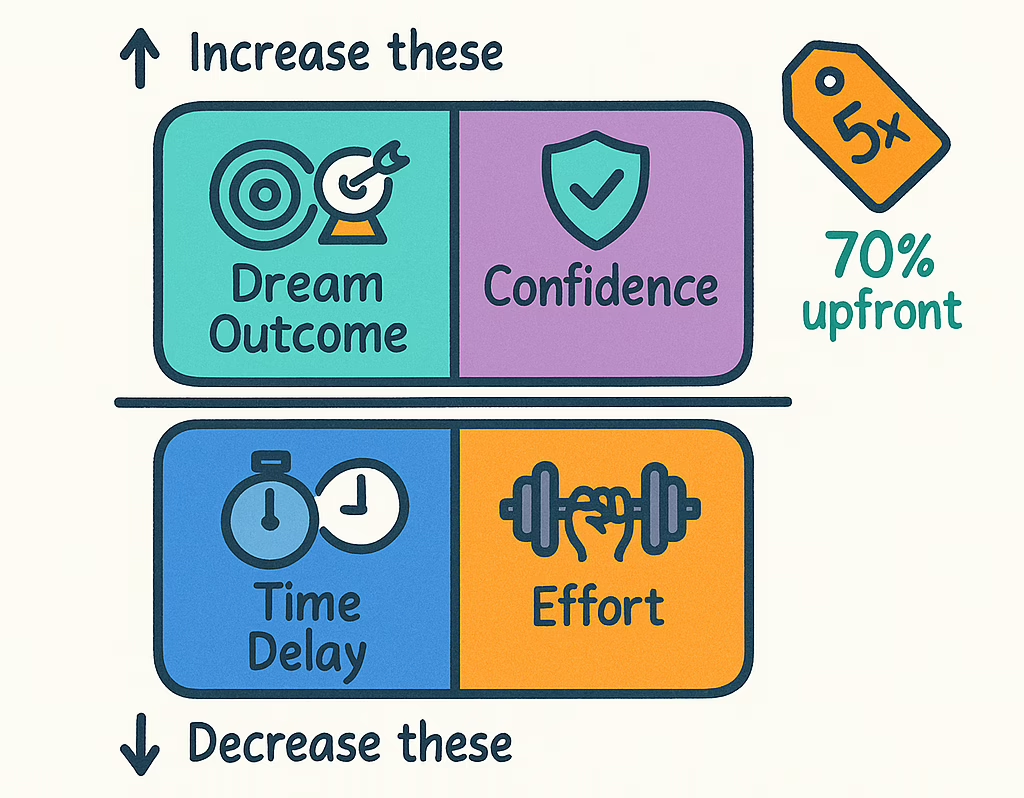
The value equation formula looks like this: Value = (Dream Outcome × Perceived Likelihood) / (Time Delay × Effort and Sacrifice). Let’s break down each part of this Hormozi offer framework.
Element 1: Dream Outcome (The Promise)
Your dream outcome is what clients want most. It’s the transformation they’re buying. The bigger the dream outcome, the more valuable your Hormozi offer becomes.
For a marketing agency, the dream outcome isn’t “social media posts.” It’s “more customers and revenue.” The Hormozi value equation teaches you to focus on outcomes, not tasks.
Service business owners often undersell their dream outcome. You think clients want deliverables. They want results. The value equation formula shows you how to position results first.
Here’s how to strengthen your dream outcome in the Hormozi offer framework:
- Make it specific and measurable
- Connect it to what clients truly want
- Show the emotional benefit
- Remove vague language
- Paint a clear before-and-after picture
Element 2: Perceived Likelihood of Achievement
Perceived likelihood is about trust and proof. Clients must believe your Hormozi offer will actually work. Without belief, even the best dream outcome won’t convert.
The value equation framework shows that proof beats promises. Case studies, testimonials, and guarantees all increase perceived likelihood. So, add them to your offer.
Many business owners promise big results but provide no proof. The Hormozi value equation formula reveals this as a fatal flaw. Clients won’t buy what they don’t believe.
Ways to increase perceived likelihood in your Hormozi offer:
- Share client success stories
- Show before-and-after examples
- Offer guarantees or warranties
- Display credentials and experience
- Use data and statistics
Research from Harvard Business Review confirms this. Social proof significantly increases conversion rates. The Hormozi value equation framework uses this principle.
Element 3: Time Delay (Speed to Result)
Time delay is how long clients wait for results. The shorter the time delay, the more valuable your Hormozi offer becomes. Speed matters to business owners.
The value equation formula treats time delay as a negative factor. Long wait times decrease perceived value. So, your Hormozi offer should promise fast results when possible.
Service businesses often struggle with time delay. Results take time. But the Hormozi value equation framework teaches you to show quick wins early. Small wins build momentum.
For example, a business coach might promise revenue growth in 90 days. But they deliver a cash flow audit in week one. That quick win reduces perceived time delay in the Hormozi offer.
Element 4: Effort and Sacrifice (The Cost)
Effort and sacrifice includes everything clients must give up. Money, time, energy, and stress all count. The Hormozi value equation shows that lower effort increases value.
Most business owners only think about price. But the value equation formula includes all costs. A cheap offer that requires 20 hours of work isn’t actually cheap.
The Hormozi offer framework teaches you to reduce friction everywhere. Make your offer easy to buy, easy to start, and easy to use. That increases perceived value dramatically.
Ways to reduce effort and sacrifice in your Hormozi offer:
- Simplify your onboarding process
- Provide done-for-you services
- Offer flexible payment plans
- Remove unnecessary steps
- Make implementation easy
The AI offer creation tool helps you apply the Hormozi value equation to your business. It analyzes all four elements and suggests improvements.
How to Use the Hormozi Value Equation Formula
Now you know the four elements. So, let’s apply the Hormozi value equation formula to your actual offer. This process transforms weak offers into strong ones.
The value equation framework isn’t just theory. It’s a practical tool. You’ll audit your current offer against all four value equation elements.
Step 1: Write Your Current Offer
Start by writing out your current offer exactly as you present it. Include your promise, deliverables, timeline, and price. The Hormozi value equation requires a clear baseline.
Most business owners discover their offer is vague when they write it down. That’s okay. The value equation formula will help you fix it.
Be honest about what you’re actually selling. Don’t write the offer you wish you had. Write the Hormozi offer you’re currently using in your business.
Step 2: Score Each Value Equation Element
Now rate each element of your Hormozi offer on a scale of 1 to 10. This is where the value equation framework reveals weaknesses.
For dream outcome, ask: Is this compelling? Does it address what clients truly want? A generic outcome scores low. A specific, emotional transformation scores high in the Hormozi value equation.
For perceived likelihood, ask: Would someone believe this? Do I have proof? Offers without testimonials or guarantees score low. The value equation formula shows this hurts conversions.
For time delay, ask: How long until clients see results? The Hormozi offer framework favors fast results. Long timelines decrease value.
For effort and sacrifice, ask: How hard is this for clients? The value equation framework teaches that friction kills sales. Easy offers score higher.
Step 3: Strengthen Each Weak Element
The Hormozi value equation now shows you where to improve. Focus on your lowest-scoring elements first. That’s where you’ll see the biggest impact.
If your dream outcome scored low, make it more specific and emotional. The value equation formula says bigger promises create more value when you can prove them.
If perceived likelihood scored low, add proof. Case studies, testimonials, and guarantees all strengthen this part of your Hormozi offer framework.
If time delay scored low, find ways to deliver quick wins. The Hormozi value equation rewards speed. Even small early results help.
If effort and sacrifice scored low, simplify everything. The value equation formula shows that easy sells better than cheap.
Expert Insight from Kateryna Quinn, Forbes Next 1000:
“When I apply the Hormozi value equation to client offers, effort always scores lowest. Business owners underestimate friction. Remove one step and conversions jump 20%. The value equation framework proves this every time.”
Step 4: Rewrite Your Offer Using the Formula
Now rewrite your offer with all improvements. Your new Hormozi offer should score 8+ on all four value equation elements.
Lead with your dream outcome. Make it bold and specific. Then immediately provide proof to increase perceived likelihood in your Hormozi value equation.
Emphasize speed and ease. The value equation formula says these reduce resistance. Show clients exactly what they’ll get and how fast.
Finally, remove every bit of unnecessary friction. The Hormozi offer framework teaches that easy always wins. Make buying, starting, and succeeding as simple as possible.
Step 5: Test Your New Offer
The Hormozi value equation is proven, but you still need to test. Run your new offer with real clients. Track conversion rates and feedback.
Most business owners see immediate results. The value equation formula works because it addresses actual buyer psychology. You’re not guessing anymore.
If conversions don’t improve, revisit your scores. The Hormozi value equation might reveal another weak element. Keep optimizing until your offer converts.
Tools like an offer value calculator can help you test different versions. The AI applies the Hormozi offer framework automatically.
Real Hormozi Offer Framework Examples
Let’s look at real examples of the Hormozi value equation in action. These show you exactly how to apply the value equation formula to different service businesses.
Example 1: Fitness Studio Offer
Before applying the Hormozi value equation:
- Dream Outcome: “Get fit”
- Perceived Likelihood: No proof
- Time Delay: “See results over time”
- Effort: $200/month, 4 classes per week
This offer is weak on all four value equation elements. It’s vague, unproven, slow, and requires high effort. The Hormozi value equation formula shows why this doesn’t convert.
After applying the Hormozi offer framework:
- Dream Outcome: “Lose 15 pounds and feel confident in 90 days”
- Perceived Likelihood: “Join 200+ clients who lost weight with our program”
- Time Delay: “See changes in week one”
- Effort: “Only 3 hours per week, all workouts planned for you”
Now the offer is specific, proven, fast, and easy. The value equation formula predicts this offer will convert much better. And it does.
Example 2: Marketing Agency Offer
Before the Hormozi value equation:
- Dream Outcome: “Social media management”
- Perceived Likelihood: “We’re experts”
- Time Delay: “Build your brand”
- Effort: $2,000/month, monthly strategy calls
This offer focuses on deliverables, not outcomes. The Hormozi value equation framework shows this is backwards. Clients don’t want posts. They want customers.
After applying the value equation formula:
- Dream Outcome: “Generate 50+ qualified leads per month”
- Perceived Likelihood: “We’ve driven $5M in client revenue”
- Time Delay: “First leads within 14 days”
- Effort: “We do everything, you approve content once weekly”
Now the Hormozi offer leads with results. It includes proof, promises speed, and removes friction. The value equation framework shows this offer has 10x more perceived value.
Example 3: Business Coach Offer
Before the Hormozi value equation:
- Dream Outcome: “Grow your business”
- Perceived Likelihood: “I have 10 years experience”
- Time Delay: “Long-term growth”
- Effort: $5,000 for 3 months, weekly calls, homework
This offer is vague and high-effort. The value equation formula reveals why clients hesitate. They don’t know what “grow” means or how long it takes.
After the Hormozi offer framework:
- Dream Outcome: “Add $10K monthly profit in 90 days”
- Perceived Likelihood: “Watch 30+ client case studies”
- Time Delay: “Increase cash flow in week one”
- Effort: “Only 2 hours weekly, we build your system”
The improved Hormozi offer is specific, proven, fast, and easy. The value equation formula predicts high conversions. Business owners see the value immediately.
According to Entrepreneur research, clear offers convert 3x better. The Hormozi value equation creates that clarity by addressing all four elements.
Common Patterns in High-Value Offers
After analyzing hundreds of offers with the Hormozi value equation, patterns emerge. Strong offers share specific traits.
First, they all use numbers. The value equation formula shows that specific promises score higher than vague ones. “Lose 15 pounds” beats “get fit.”
Second, they all include proof. The Hormozi offer framework requires social proof. Without it, perceived likelihood stays low. With it, conversions double.
Third, they all promise quick wins. The value equation framework shows that time delay kills deals. Smart offers deliver small results fast to reduce perceived wait time.
Fourth, they all remove friction. The Hormozi value equation treats effort as a deal-breaker. High-value offers do the work for clients.
Build Your Offer with an AI Offer Builder
You now understand the Hormozi value equation. But applying the value equation formula manually takes time. An AI offer creation tool speeds up the process dramatically.
Uplify’s AI offer builder applies the Hormozi offer framework automatically. You answer questions about your business. The AI analyzes your offer against all four value equation elements.
How the AI Offer Creation Tool Works
The AI offer builder starts by asking about your current offer. What do you sell? Who do you serve? What results do clients get?
Then it applies the Hormozi value equation formula to your answers. It scores each element of the value equation framework. Low scores reveal where your offer is weak.
Next, the AI suggests specific improvements. If your dream outcome is vague, it rewrites it using the Hormozi offer framework. If you lack proof, it tells you exactly what to add.
Finally, the offer value calculator generates multiple offer versions. Each one follows the value equation formula. You pick the strongest Hormozi offer for your business.
Benefits of Using an AI Offer Tool
The AI offer creation tool saves hours of work. Manual offer optimization with the Hormozi value equation takes days. The AI does it in minutes.
It also removes guesswork. The value equation formula is proven, but applying it correctly requires skill. The AI ensures you follow the Hormozi offer framework perfectly.
Business owners who use the AI see faster results. The tool identifies weak elements you might miss. Then it fixes them using the value equation formula automatically.
Most importantly, the AI offer builder connects to your broader offer creation strategy. It’s part of a complete system for building and testing offers that convert.
Real Results from AI-Powered Offers
Business owners using Uplify’s AI offer creation tool see immediate improvements. The Hormozi value equation framework works, and the AI applies it flawlessly.
One fitness studio owner increased sign-ups by 40% after using the tool. The AI strengthened her dream outcome and added proof. The value equation formula predicted the improvement.
A marketing agency doubled their close rate. The AI showed them their time delay was too long. They added quick wins to their Hormozi offer. Conversions jumped.
A business coach tripled her prices without losing clients. The AI revealed her effort and sacrifice score was too high. She simplified onboarding using the value equation framework.
Expert Insight from Kateryna Quinn, Forbes Next 1000:
“I use the AI offer builder for every new client. It catches things I miss. The Hormozi value equation is simple, but humans overlook details. The AI never does. Your offer improves every time.”
Getting Started with the AI Tool
Ready to apply the Hormozi value equation to your offer? Start with Uplify’s AI offer creation tool today.
The tool walks you through each element of the value equation formula. You’ll see exactly where your offer is weak. Then you’ll get specific fixes based on the Hormozi offer framework.
Most business owners finish their new offer in under 30 minutes. The AI does the heavy lifting. You just answer questions and choose your favorite Hormozi offer version.
Try it now and see how the value equation framework transforms your offer. You’ll understand why clients say yes or no. Then you’ll fix the problem permanently.
Frequently Asked Questions
What is the Hormozi value equation?
The Hormozi value equation is a formula for creating high-value offers. It has four elements: dream outcome, perceived likelihood, time delay, and effort. Alex Hormozi created this value equation framework. Business owners use the value equation formula to increase conversions. The Hormozi offer framework shows you exactly what makes offers valuable.
How do I use the value equation formula?
First, write your current offer down clearly. Then score each Hormozi value equation element from 1 to 10. Strengthen weak elements using the value equation framework. Rewrite your offer with improvements. Test your new Hormozi offer with real clients. The value equation formula guides every step of this process.
Why does the Hormozi offer framework work?
The Hormozi value equation works because it addresses buyer psychology. Clients care about outcomes, proof, speed, and ease. The value equation formula optimizes all four factors. When your Hormozi offer scores high on every element, conversions increase. The value equation framework removes guesswork from offer creation.
What is an AI offer builder?
An AI offer creation tool applies the Hormozi value equation automatically. You input your business details. The AI scores your offer using the value equation formula. Then it suggests improvements based on the Hormozi offer framework. The tool saves time and ensures you follow the value equation correctly.
Can the value equation work for any business?
Yes, the Hormozi value equation works for all service businesses. Coaches, agencies, consultants, and local businesses all benefit. The value equation formula is universal because buyer psychology is universal. Every Hormozi offer needs strong outcomes, proof, speed, and ease. The value equation framework applies to every industry.
How to Apply the Hormozi Value Equation: 10 Steps
- Write out your current offer exactly as you present it now.
- Rate your dream outcome from 1 to 10 for specificity and emotional appeal.
- Rate your perceived likelihood from 1 to 10 based on proof and credibility.
- Rate your time delay from 1 to 10 for speed to first results.
- Rate your effort and sacrifice from 1 to 10 for ease and simplicity.
- Identify your lowest-scoring value equation element as your main weakness.
- Strengthen that element using the Hormozi offer framework principles.
- Rewrite your complete offer with all improvements integrated throughout.
- Test your new Hormozi offer with at least 10 real prospects.
- Track conversion rates and adjust based on the value equation formula.
Quick Reference: Hormozi Value Equation Definition
The Hormozi value equation is a formula that shows you how to create irresistible offers. Created by Alex Hormozi, the value equation formula states: Value = (Dream Outcome × Perceived Likelihood) / (Time Delay × Effort and Sacrifice). The Hormozi offer framework helps business owners increase conversions by optimizing all four elements. Dream outcome is what clients want. Perceived likelihood is proof and trust. Time delay is speed to results. Effort and sacrifice is total cost. When you strengthen the top factors and reduce the bottom factors, your Hormozi offer becomes more valuable. The value equation framework works for all service businesses. An AI offer creation tool can apply the Hormozi value equation automatically. Business owners use the value equation formula to double or triple conversions. The Hormozi offer framework removes guesswork from pricing and positioning. Every offer should score 8 or higher on all four value equation elements.
Transform Your Offer Today
The Hormozi value equation gives you a proven system for offer creation. You now know all four elements of the value equation formula. You’ve seen real examples of the Hormozi offer framework in action.
Most business owners never fix their offers. They keep guessing and hoping. The value equation framework removes that uncertainty. You know exactly what makes offers valuable.
Start by scoring your current offer against the Hormozi value equation. Find your weakest element. Then fix it using the strategies in this guide.
Or use Uplify’s AI offer builder to apply the value equation formula automatically. The AI analyzes your business and creates multiple Hormozi offer versions in minutes.
Your offer is the foundation of your business. The Hormozi value equation ensures that foundation is rock solid. Stop losing clients to weak offers. Apply the value equation framework today.

Kateryna Quinn is an award-winning entrepreneur and founder of Uplify, an AI-powered platform helping small business owners scale profitably without burnout. Featured in Forbes (NEXT 1000) and NOCO Style Magazine (30 Under 30), she has transformed hundreds of service-based businesses through her data-driven approach combining business systems with behavior change science. Her immigrant background fuels her mission to democratize business success.