Your business works hard. You deliver great service. Yet clients still compare you to everyone else.
That stops with a strong positioning statement. A positioning statement is a short message that shows customers why you’re different. It guides every business decision you make. Plus, it helps your team stay focused on what matters most.
Most small business owners skip this step. They think a tagline is enough. But a positioning statement does something deeper. It defines who you serve, what problem you solve, and why customers should choose you over all other options.
As a Forbes Next 1000 honoree who built a marketing agency from $3K to $34K monthly, I’ve seen how the right positioning statement transforms businesses. When you nail this message, everything else gets easier. Your marketing feels clear. Your sales conversations flow better. And your team knows exactly what to deliver.
This guide shows you how to create your positioning statement. You’ll get proven templates, real examples, and step-by-step instructions. By the end, you’ll have a positioning statement that sets your business apart.
Table of Contents
- What Is a Positioning Statement and Why Your Business Needs One
- Positioning Statement vs Value Proposition: Key Differences
- Essential Elements Every Positioning Statement Must Include
- Proven Positioning Statement Templates You Can Use Today
- Real Positioning Statement Examples from Successful Businesses
- How to Write Your Positioning Statement (Step-by-Step Guide)
- Common Positioning Statement Mistakes to Avoid
- How to Use Your Positioning Statement in Daily Operations
- FAQs About Positioning Statements
What Is a Positioning Statement and Why Your Business Needs One
A positioning statement defines your unique place in the market. It’s a short, clear message that explains who you serve and why they should choose you. Unlike your tagline or slogan, a positioning statement lives inside your business. It guides your team’s decisions every single day.
Think of your positioning statement as your business compass. When you face a tough choice, your positioning statement shows the right path. Should you add a new service? Your positioning statement helps you decide. Should you target a new market? Your positioning statement gives the answer.
The U.S. Small Business Administration notes that market positioning directly affects business success. Without clear positioning, you compete on price alone. But with strong positioning, you compete on value. That’s the difference between struggling and thriving.
Your positioning statement serves three main purposes. First, it keeps your team aligned on your target customer. Second, it clarifies what makes you different from competitors. Third, it ensures consistent messaging across all channels. When everyone knows your positioning statement, your business runs smoother.
Many service businesses avoid creating a positioning statement. They think it takes too much time. Or they believe their business is too unique to fit a template. But the truth is simple. Every successful business has clear positioning. The ones that skip this step stay stuck fighting for attention.
Your positioning statement builds the foundation for everything else. It informs your value proposition, shapes your offers, and guides your marketing. Get this right, and the rest of your business strategy falls into place. Skip it, and you’ll always wonder why customers don’t see your value.
A strong positioning statement focuses your efforts. Instead of trying to serve everyone, you serve your ideal customer better than anyone else. Instead of offering everything, you offer what matters most. This focus doesn’t limit your business. It powers your growth.
Positioning Statement vs Value Proposition: Key Differences
Many business owners confuse positioning statements with value propositions. They’re related but serve different roles. Understanding this difference helps you use both tools effectively.
A positioning statement is your internal guide. It lives inside your business and directs your team. Your positioning statement is shorter and more strategic. It focuses on who you serve, what you deliver, and why you’re different. You use your positioning statement to make business decisions.
A value proposition is your external message. It lives on your website and in your marketing. Your value proposition is longer and more detailed. It explains the specific benefits customers get when they choose you. You use your value proposition to convert prospects into paying clients.
Here’s a simple way to remember the difference. Your positioning statement answers “Who are we?” Your value proposition answers “Why should customers buy from us?” Both messages must align, but they serve different audiences and purposes.
Your positioning statement typically includes four elements. First, your target market. Second, your market category. Third, your key benefit. Fourth, your competitive advantage. These elements create a clear picture of where you fit in the marketplace.
Your value proposition typically includes more elements. It adds specific outcomes, proof points, features, and calls to action. Your value proposition takes your positioning statement and expands it into customer-facing language. Think of it as translating strategy into sales.
The Forbes Business Council emphasizes that positioning drives everything else in your marketing. Your positioning statement comes first. Then you build your value proposition from that foundation. Try to skip positioning, and your value proposition lacks direction.
Most small businesses start with features. They list what they do without explaining who it’s for or why it matters. But effective positioning starts with your target customer. Once you know who you serve, you can craft messages that resonate with them deeply.
Your positioning statement typically stays private. You share it with your team, investors, and key partners. Your value proposition goes public. It appears on your website, in ads, and in sales conversations. Both work together to build your brand.
Essential Elements Every Positioning Statement Must Include
Every effective positioning statement contains four core elements. These elements work together to create a clear, compelling message. Miss one element, and your positioning statement loses power.
Element 1: Target Market
Your target market is who you serve. Be specific. Don’t say “small businesses.” Say “small law firms with 5-20 employees.” The more specific you get, the stronger your positioning becomes. Generic targets create generic positioning.
Your target market should reflect who you serve best. Think about your happiest customers. What do they have in common? That’s your target market. When you focus on a specific group, you can tailor everything to their needs.
Element 2: Market Category
Your market category is what you do. It places your business in a familiar context. Are you a marketing agency, accounting firm, or consulting service? Your market category helps customers understand you quickly.
Choose a category that customers already recognize. Avoid making up new categories. Customers need to understand what you do in seconds. If they don’t recognize your category, they’ll move on to someone they understand.
Element 3: Key Benefit
Your key benefit is the main outcome customers get. Focus on one primary benefit. Trying to include every benefit dilutes your message. Pick the benefit that matters most to your target market.
Your key benefit should be tangible and specific. Don’t say “we help businesses grow.” Say “we help businesses double their revenue in 12 months.” Specific benefits create specific expectations. And specific expectations lead to satisfied customers.
Element 4: Competitive Advantage
Your competitive advantage is what makes you different. It’s why customers should choose you over alternatives. Your competitive advantage could be your process, your speed, your expertise, or your results. Whatever makes you unique goes here.
Your competitive advantage must be defensible. Don’t claim something any competitor could copy tomorrow. Pick an advantage rooted in your unique experience, method, or team. The U.S. Chamber of Commerce research shows that sustainable competitive advantages drive long-term business success.
These four elements create the framework for your positioning statement. Some templates add additional elements. But these four form the core. Master these, and you’ll have a strong positioning statement that guides your business forward.
Proven Positioning Statement Templates You Can Use Today
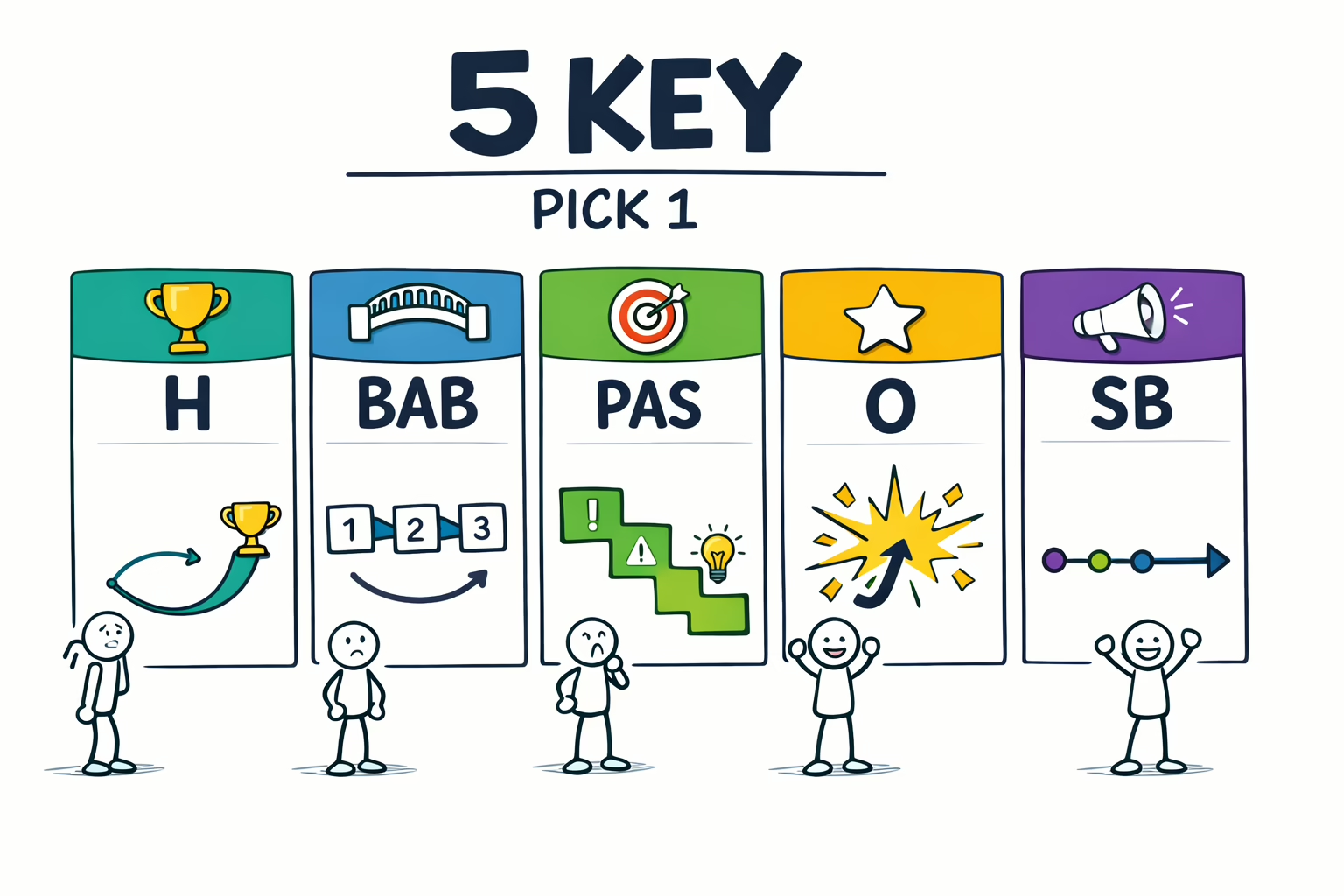
Templates make creating your positioning statement easier. These proven templates work across industries and business types. Choose the template that fits your business best.
Template 1: Classic Positioning Statement
For [target market] who [target market need], [business name] is a [market category] that [key benefit]. Unlike [key competition], we [competitive advantage].
Example: For busy small business owners who need professional marketing but lack time, Uplify is an AI business platform that delivers proven marketing strategies in minutes. Unlike generic AI tools, we combine business coaching with industry-specific AI agents.
Template 2: Problem-Solution Positioning
We help [target market] [achieve specific outcome] without [common pain point]. Our [market category] delivers [key benefit] through [unique approach].
Example: We help service business owners scale to seven figures without burning out. Our AI business platform delivers systematic growth through daily actions and AI tools that work with your business data.
Template 3: Benefit-Focused Positioning
[Business name] provides [target market] with [key benefit] so they can [desired outcome]. We’re the only [market category] that [competitive advantage].
Example: Uplify provides small business owners with predictable profit growth so they can finally pay themselves what they deserve. We’re the only AI business platform that combines 18-level roadmaps with industry-trained AI tools.
Template 4: Market Leader Positioning
As the [competitive position] in [market category], [business name] helps [target market] [achieve key benefit] through [unique method or approach].
Example: As the first AI-powered business operating system for service businesses, Uplify helps small business owners achieve profitable growth through daily lessons and purpose-built AI tools.
Template 5: Value-Based Positioning
We believe [core belief about market or customers]. That’s why [business name] created [market category] specifically for [target market] to [key benefit] using [competitive advantage].
Example: We believe every small business owner deserves a system that makes success inevitable. That’s why Uplify created an AI business platform specifically for service businesses to grow profitably using tools trained on real business success.
Each template works for different situations. Test multiple templates. See which one feels most natural for your business. The right template makes your positioning statement clear and compelling.
Your positioning statement should feel true. Don’t force words that don’t fit your business. Use these templates as starting points. Then customize them until they sound like you.
Real Positioning Statement Examples from Successful Businesses
Real examples show how positioning statements work in practice. These examples come from various industries. Study them to understand what makes positioning statements powerful.
Example 1: Professional Services Firm
“For growing companies who need expert legal guidance without law firm overhead, Miller & Associates is a boutique business law firm that provides strategic counsel at transparent rates. Unlike large firms, we respond within 24 hours and bill by results, not hours.”
Why this works: This positioning statement is specific about the target (growing companies), clear about the benefit (expert guidance without overhead), and highlights two distinct advantages (response time and billing method).
Example 2: Local Service Business
“For homeowners who want premium landscaping services they can trust, GreenScape is a full-service landscaping company that creates outdoor spaces that increase property value. Unlike contractors who disappear between projects, we provide year-round maintenance and guaranteed response times.”
Why this works: This positioning statement addresses a common pain point (unreliable contractors), emphasizes trust and value, and offers a unique commitment (year-round service with guarantees).
Example 3: B2B Software Company
“For accounting firms struggling with manual data entry, DataFlow is automation software that eliminates 15+ hours of weekly admin work. Unlike generic automation tools, we’re built specifically for accounting workflows and integrate with every major accounting platform.”
Why this works: This positioning statement quantifies the benefit (15+ hours saved), shows industry expertise (built for accounting), and demonstrates practical advantages (platform integrations).
Example 4: Coaching and Consulting
“For coaches building their first online business, LaunchPath is a business coaching program that takes you from idea to first $10K in revenue. Unlike generic business courses, we provide weekly 1-on-1 coaching and proven templates for every step.”
Why this works: This positioning statement targets a specific stage (first online business), sets clear expectations ($10K milestone), and differentiates through personalized support.
Example 5: E-commerce Business
“For parents seeking natural skincare for sensitive skin, PureKids is an organic skincare line that’s dermatologist-tested and safe for babies. Unlike drugstore brands with harsh chemicals, every product uses certified organic ingredients with transparent sourcing.”
Why this works: This positioning statement addresses parental concerns (safety), builds credibility (dermatologist-tested), and emphasizes transparency that matters to the target market.
These examples demonstrate key principles. First, they’re specific about who they serve. Second, they highlight measurable benefits. Third, they clearly state what makes them different. Fourth, they use language their target market understands.
Notice how each positioning statement follows a consistent structure. They start with the target market. Then they define the category. Next they explain the key benefit. Finally they differentiate from competition. This structure keeps positioning statements clear and focused.
How to Write Your Positioning Statement (Step-by-Step Guide)
Creating your positioning statement takes focused effort. Follow these steps to craft a positioning statement that guides your business effectively.
Step 1: Define Your Target Market
Start by identifying who you serve best. Look at your current customers. Which ones do you enjoy working with most? Which ones get the best results? Those customers represent your target market.
Get specific about demographics and psychographics. Write down their industry, company size, revenue level, and role. Then note their challenges, goals, and values. The more detail you include, the stronger your positioning becomes.
Avoid the temptation to serve everyone. Focus creates power. When you try to appeal to everyone, you appeal to no one. Pick your ideal customer and build your positioning statement around them.
Step 2: Clarify Your Market Category
Determine what category your business fits into. Choose a category customers already understand. If you need to explain what your category means, pick a simpler one.
Your category provides context. It helps customers quickly understand what you do. Don’t try to create a new category unless you have massive marketing resources. Stick with familiar categories that make instant sense.
Step 3: Identify Your Key Benefit
Decide on the main outcome customers get when they work with you. What’s the primary transformation you deliver? Focus on results, not features.
Your key benefit should solve your target market’s biggest problem. Don’t list every benefit. Pick the one that matters most. This focus makes your positioning statement memorable and actionable.
Talk to your best customers. Ask them what they value most about working with you. Their answers reveal your key benefit. Often, customers see benefits you take for granted. Listen carefully to their language.
Step 4: Determine Your Competitive Advantage
Figure out what makes you genuinely different from competitors. Study your competition. Note what they promise and how they deliver. Then identify where you excel beyond them.
Your competitive advantage must be real and sustainable. Don’t claim advantages you can’t deliver. Customers will discover the truth quickly. Build your competitive advantage on your unique strengths, experience, or methods.
Consider these potential competitive advantages. Do you respond faster than competitors? Do you offer better guarantees? Do you have specialized expertise? Do you use a proprietary process? Do you deliver better results? Pick the advantage that matters most to your target market.
Step 5: Choose Your Template
Select a positioning statement template from the options provided earlier. Don’t feel locked into one template. Try several. See which one captures your positioning most clearly.
Your template provides structure. But your content makes your positioning statement unique. Focus more on what you say than how you say it. Clarity beats cleverness every time.
Step 6: Write Your First Draft
Fill in your chosen template with the information from steps 1-4. Don’t worry about perfection yet. Just get your positioning statement on paper. You’ll refine it in the next steps.
Read your draft out loud. Does it sound natural? Does it make sense? If it feels awkward, adjust your wording. Your positioning statement should roll off the tongue easily.
Step 7: Test and Refine
Share your positioning statement draft with team members, trusted advisors, and even a few customers. Get their feedback. Do they understand it? Does it resonate? Do they see your differentiation clearly?
Use their feedback to refine your positioning statement. Adjust words that confuse people. Clarify benefits that seem vague. Strengthen advantages that need more proof.
Step 8: Validate Your Positioning
Test your positioning statement in real situations. Use it to guide a marketing decision. Use it in a sales conversation. See if it helps or hinders. Effective positioning statements make decisions easier.
If your positioning statement doesn’t guide decisions well, revise it. Keep testing until your positioning statement becomes a reliable tool for your business.
Step 9: Document and Share
Once you’re satisfied with your positioning statement, document it. Share it with everyone in your business. Make sure your entire team understands your positioning and can explain it clearly.
Create a simple document that includes your positioning statement plus an explanation of each element. This document becomes your positioning reference guide. Use it to onboard new team members and keep everyone aligned.
Step 10: Review Regularly
Plan to review your positioning statement every 6-12 months. Markets change. Competitors evolve. Your business grows. Your positioning statement may need updates to stay relevant and effective.
Don’t change your positioning statement too often. Consistency builds recognition. But don’t cling to outdated positioning either. Balance stability with adaptability.
Common Positioning Statement Mistakes to Avoid
Most businesses make predictable mistakes when creating positioning statements. Avoid these errors to build stronger positioning from the start.
Mistake 1: Being Too Generic
Generic positioning statements help nobody. Saying you serve “small businesses” or “people who need help” wastes your positioning statement’s power. Be specific about who you serve and what problems you solve.
Generic positioning makes you forgettable. Customers can’t remember vague messages. They remember specific claims about specific problems. The more specific your positioning statement, the more memorable your business becomes.
Mistake 2: Listing Features Instead of Benefits
Features describe what you do. Benefits describe what customers get. Most businesses focus on features because they’re easier to identify. But customers care about outcomes, not activities.
Transform your features into benefits. Instead of “we offer 24/7 support,” say “you get answers whenever you need them.” Instead of “we use advanced technology,” say “you save 10 hours per week.” Benefits matter more than features.
Mistake 3: Copying Competitors
Some businesses look at successful competitors and copy their positioning statements. This approach fails for two reasons. First, you can’t out-position an established competitor by copying them. Second, copying creates confusion in the marketplace.
Build positioning that highlights what makes you genuinely different. Study competitors to understand what they claim. Then position yourself in a way they can’t match. Your unique combination of target market, benefits, and advantages creates your positioning.
Mistake 4: Trying to Appeal to Everyone
Broad positioning dilutes your message. When you try to serve everyone, you serve no one well. Customers want specialists, not generalists. Focus your positioning on your ideal customer.
Some business owners fear that narrow positioning limits their opportunities. The opposite is true. Narrow positioning attracts more of your ideal customers. And ideal customers become your best advocates, referring others like themselves.
Mistake 5: Using Industry Jargon
Your positioning statement should use language your target market understands. Industry jargon alienates customers who don’t know technical terms. Keep your language simple and clear.
Read your positioning statement to someone outside your industry. If they don’t understand it immediately, simplify your language. Clarity beats sophistication every time.
Mistake 6: Making Unsubstantiated Claims
Don’t claim advantages you can’t prove or deliver. Customers will test your claims. If you promise “fastest response times” but take days to respond, your positioning backfires. Only claim advantages you consistently deliver.
Support your positioning statement with proof. If you claim superior results, have case studies ready. If you promise faster service, track your response times. Your positioning statement sets expectations. Make sure you exceed them.
Mistake 7: Creating Multiple Positioning Statements
Some businesses create different positioning statements for different audiences. This approach confuses your market and dilutes your brand. Stick with one clear positioning statement.
Your positioning statement can inform how you communicate with different audiences. But your core positioning should remain consistent. Consistency builds recognition and trust.
How to Use Your Positioning Statement in Daily Operations
Your positioning statement should guide real business decisions. Here’s how to put your positioning statement to work every day.
Use Positioning in Marketing Decisions
Before launching any marketing campaign, check it against your positioning statement. Does this campaign speak to your target market? Does it highlight your key benefit? Does it reinforce your competitive advantage? If not, revise the campaign.
Your positioning statement ensures marketing consistency. Every email, social post, and ad should align with your positioning. When your marketing stays consistent with your positioning, customers remember you better.
Use Positioning in Sales Conversations
Train your sales team to use your positioning statement as a conversation guide. When prospects ask what makes you different, your positioning statement provides the answer. When they wonder if you’re right for them, your positioning statement helps them decide.
Your positioning statement should inform your sales scripts, proposals, and presentations. Don’t copy your positioning statement word-for-word. Instead, use it as a framework to structure your sales conversations naturally.
Use Positioning in Product Development
Should you add a new service? Check your positioning statement. Does this new service align with your target market? Does it reinforce your key benefit? Does it strengthen your competitive advantage? If yes, consider adding it. If no, skip it.
Your positioning statement prevents scope creep. It keeps you focused on serving your ideal customer well instead of chasing every opportunity. This focus creates better products and happier customers.
Use Positioning in Hiring Decisions
Share your positioning statement with job candidates. Look for team members who understand and embrace your positioning. The right team members strengthen your positioning through their daily work.
During interviews, explain how your positioning statement guides business decisions. Ask candidates how they would apply your positioning in their role. Their answers reveal whether they’ll fit your culture.
Use Positioning in Partnership Decisions
Before partnering with another business, evaluate the fit against your positioning statement. Do they serve your target market? Do they share your values? Will the partnership strengthen or weaken your positioning?
Strategic partnerships can amplify your positioning. But misaligned partnerships dilute it. Be selective about who you partner with. Choose partners who enhance your positioning statement, not compromise it.
Use Positioning in Crisis Management
When problems arise, use your positioning statement to guide your response. How would your target market want you to handle this situation? What response aligns with your key benefit? What action reinforces your competitive advantage?
Your positioning statement provides clarity during stressful times. It reminds you what matters most to your business and your customers. This clarity leads to better decisions under pressure.
Frequently Asked Questions About Positioning Statements
Q1: How long should a positioning statement be?
A positioning statement should be 1-3 sentences long. It needs to be short enough that everyone in your business can remember it. But it must be complete enough to include all four core elements. Most effective positioning statements are 30-75 words total. If yours exceeds 100 words, it’s too long. Cut extra words until only the essential message remains.
Q2: What’s the difference between a positioning statement and a mission statement?
Your mission statement explains why your business exists. It describes your overall purpose and values. A positioning statement explains where you fit in the market. It describes who you serve, what you deliver, and why customers choose you. Mission statements inspire your team internally. Positioning statements guide your business strategy. Both are important but serve different purposes.
Q3: How often should I update my positioning statement?
Review your positioning statement every 6-12 months. Markets change. Competitors evolve. Your business grows. Small adjustments keep your positioning statement relevant. But avoid changing your core positioning too frequently. Consistency builds brand recognition. Only make major changes when your target market shifts significantly or your competitive advantage fundamentally changes.
Q4: Can I use my positioning statement in my marketing?
Your positioning statement guides your marketing, but it’s not designed for direct use in ads or websites. Positioning statements use internal language focused on strategy. For customer-facing messages, create a value proposition based on your positioning statement. Your value proposition translates your positioning into customer language that drives conversions.
Q5: What if my business serves multiple target markets?
Focus your positioning statement on your primary target market. The market that generates most revenue or the market you want to grow. You can create secondary positioning statements for other markets. But start with one clear positioning statement for your main market. Trying to serve multiple markets in one positioning statement creates confusion.
Q6: How do I know if my positioning statement is working?
A working positioning statement makes business decisions easier. If your team regularly references your positioning statement when making choices, it’s working. If customers understand what makes you different, it’s working. If your marketing feels consistent and focused, it’s working. Track metrics like customer acquisition cost, conversion rates, and brand recognition to measure positioning effectiveness.
Q7: What if my competitors copy my positioning statement?
Build your positioning on advantages competitors can’t easily replicate. Focus on your unique experience, proprietary methods, or specialized expertise. If competitors copy your exact words, that validates your positioning strength. But they can’t copy your actual delivery. Your team, process, and results create sustainable differentiation beyond words.
Q8: Should I include pricing in my positioning statement?
Only include pricing if it’s your primary competitive advantage. Most positioning statements focus on target market, category, benefits, and unique approach. Pricing can be part of your competitive advantage statement. For example, “unlike premium-priced competitors, we deliver enterprise results at mid-market rates.” But avoid making price your only differentiator.
Quick Reference: What Is a Positioning Statement?
A positioning statement is a strategic tool that defines your unique place in the market. It’s a clear, internal message that guides your business decisions by explaining who you serve, what problem you solve, and why customers should choose you.
Your positioning statement contains four essential elements. First, your target market describes your ideal customer. Second, your market category places your business in a familiar context. Third, your key benefit explains the main outcome customers get. Fourth, your competitive advantage shows what makes you different from alternatives.
Businesses use positioning statements to maintain strategic focus across all operations. Your positioning statement informs marketing campaigns, guides product development, shapes hiring decisions, and directs sales conversations. When everyone in your business understands your positioning statement, your entire organization moves in the same direction.
A strong positioning statement is specific, benefit-focused, and defensible. It avoids generic language that applies to any business. Instead, it highlights what makes your business uniquely valuable to your target market. This clarity helps customers understand why they should choose you.
Step-by-Step: How to Create Your Positioning Statement
Creating an effective positioning statement follows a clear process. Start by identifying your target market. Look at your best customers. What characteristics do they share? Write down specific details about their industry, size, role, and challenges.
Next, define your market category. Choose a category customers already understand. Avoid creating new categories unless you have major marketing resources. Familiar categories help customers quickly grasp what you do.
Then, clarify your key benefit. What’s the main outcome customers get when they work with you? Focus on results, not features. Talk to customers to discover what they value most.
After that, determine your competitive advantage. Study your competitors. Note what they promise and how they deliver. Then identify where you excel beyond them. Your advantage must be real and sustainable.
Now choose a positioning statement template. Try several templates to find the best fit. Fill in your chosen template with your market, category, benefit, and advantage.
Write your first draft. Read it aloud to check for clarity. Share it with team members and advisors for feedback. Use their input to refine your positioning statement.
Test your positioning in real business situations. Does it help guide decisions? Does it make your differentiation clear? If not, keep refining until it works effectively.
Finally, document your positioning statement. Share it with your entire team. Make sure everyone understands how to use it in their daily work. Review your positioning statement every 6-12 months to keep it current.
Take Action: Build Your Positioning Statement Today
Your positioning statement guides everything in your business. It clarifies who you serve. It focuses your marketing. And it helps customers understand why they should choose you.
Start creating your positioning statement today. Use the templates and examples in this guide. Follow the step-by-step process. Don’t worry about perfection initially. Just get your first draft written.
Remember, every successful business has clear positioning. The ones that skip this step stay stuck competing on price. But businesses with strong positioning statements compete on value instead.
If you want help creating your complete business strategy including positioning, Uplify’s AI business platform guides you through every step. Our Value Proposition Builder helps you clarify your unique message in minutes. Plus, our 18-level roadmap shows exactly what actions to take next based on where your business stands today.
Your positioning statement is your foundation. Build it right, and everything else gets easier. Start now, and watch how clarity transforms your business.

Kateryna Quinn is an award-winning entrepreneur and founder of Uplify, an AI-powered platform helping small business owners scale profitably without burnout. Featured in Forbes (NEXT 1000) and NOCO Style Magazine (30 Under 30), she has transformed hundreds of service-based businesses through her data-driven approach combining business systems with behavior change science. Her immigrant background fuels her mission to democratize business success.