Will AI agents replace jobs? This question keeps business owners up at night. The answer is more nuanced than most think. AI agents are changing how we work. They won’t replace all jobs. But they will change most roles. Understanding this shift helps you prepare.
This guide explains AI job automation clearly. You’ll learn what AI agents do well. You’ll see where humans remain essential. You’ll discover how to position yourself in this new landscape. Most importantly, you’ll learn to work alongside AI agents. This skill matters more every day.
I’ve helped hundreds of businesses navigate AI adoption. My agency generated over $25M in client revenue. I’ve seen firsthand how AI transforms workflows. The businesses that thrive don’t fight AI. They embrace it strategically. This guide shows you how.
Table of Contents
- Understanding Will AI Agents Replace Jobs
- The Reality of AI Job Automation
- How AI Agents Transform Work
- Positioning Yourself in the AI Workforce
- Working Alongside AI Agents
- The Future of AI and Jobs
- Frequently Asked Questions
Understanding Will AI Agents Replace Jobs
The impact of AI on jobs varies by industry. Some roles face complete automation. Others see partial transformation. Most jobs will change, not disappear. AI agents handle repetitive tasks exceptionally well. They process data faster than humans. They work 24/7 without breaks.
But AI agents lack human judgment. They can’t understand emotional nuance. They struggle with creative problem-solving. They need human oversight for complex decisions. This creates a partnership model. Humans guide strategy while AI executes tactics.
What AI Agents Do Best
AI agents excel at data processing. They analyze patterns quickly. They automate routine communications effectively. Research from the SBA business management guide shows automation increases efficiency. AI handles scheduling seamlessly. It manages basic customer inquiries well.
These tools generate reports instantly. They track metrics continuously. They flag anomalies automatically. This frees humans for strategic work. Your time becomes more valuable. You focus on growth, not grunt work.
Where Humans Remain Essential
Complex decision-making requires human insight. Relationship building needs emotional intelligence. Creative strategy demands human innovation. Crisis management requires adaptive thinking. These skills remain irreplaceable today.
Clients still want human connection. They trust people, not algorithms. Your judgment matters in negotiations. Your creativity drives competitive advantage. Your empathy builds lasting relationships. AI supports these strengths. It doesn’t replace them.
The Partnership Model
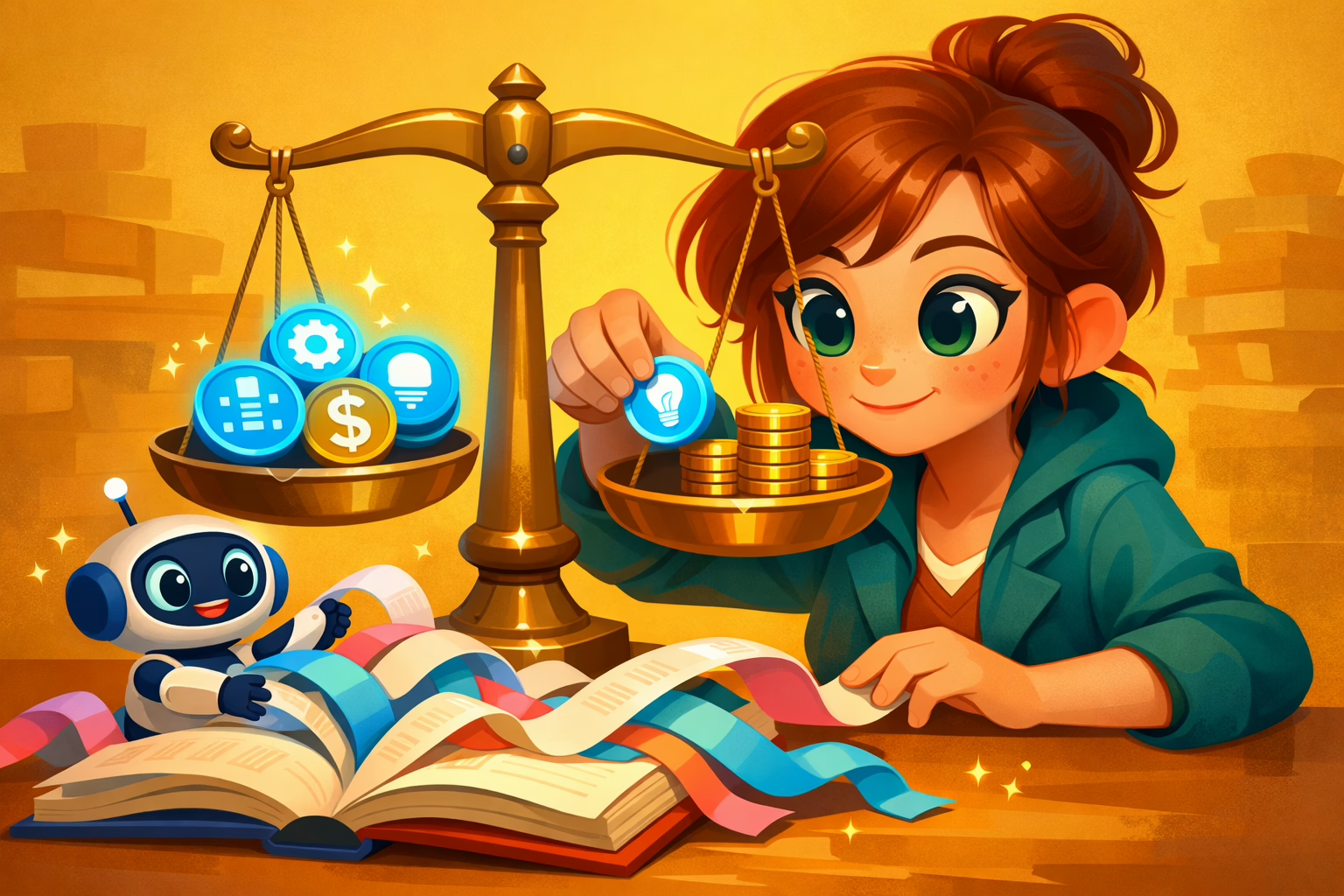
The AI workforce debate misses this point. It’s not humans versus AI. It’s humans with AI versus humans without. The real question becomes: Will you adapt? Those who learn AI tools gain advantage. Those who resist fall behind.
Smart business owners embrace this shift. They use AI for routine tasks. They focus their energy on high-value work. This approach multiplies their impact. One person with AI can outperform a team without it.
The Reality of AI Job Automation
Will AI agents replace jobs completely? The data tells a complex story. Some positions face displacement. Most roles undergo transformation. New opportunities emerge constantly. Understanding these patterns helps you plan.
AI job automation affects different sectors differently. Customer service sees significant change. Data entry faces near-complete automation. Creative fields experience augmentation. Leadership roles remain human-centered. Technical skills become more valuable.
Jobs Most Affected by AI
Data entry positions decline rapidly. Basic bookkeeping becomes automated. Simple customer service shifts to chatbots. Routine scheduling no longer needs humans. These changes accelerate yearly.
But even affected roles don’t vanish entirely. They evolve into oversight positions. Workers become AI managers instead. They handle exceptions and complexities. They improve AI systems continuously. The role changes, not disappears.
Jobs That Grow with AI
AI creates new job categories. AI trainers teach systems constantly. AI ethicists ensure responsible use. Integration specialists connect AI tools. Insights from proven business growth strategies show adaptation drives success.
Strategic roles become more valuable. Leaders who leverage AI excel. Creative professionals using AI outperform peers. Sales professionals with AI tools close more deals. Marketing experts with AI reach more customers. The pattern is clear: AI amplifies human capability.
The Skill Shift
The impact of AI on jobs demands new skills. Technical literacy becomes essential. AI tool proficiency separates winners from losers. But soft skills matter more than ever. Communication, creativity, and critical thinking can’t be automated.
You don’t need to become a programmer. You need to understand AI capabilities. You must know when to use AI. You should recognize its limitations. This understanding creates competitive advantage. Our AI agents for business guide explores these opportunities deeply.
How AI Agents Transform Work
AI agents change daily workflows dramatically. They automate repetitive tasks first. They enhance decision-making processes next. They create entirely new possibilities eventually. Understanding this progression helps you adapt proactively.
Will AI agents replace jobs or transform them? The answer depends on your response. Businesses that integrate AI thoughtfully thrive. Those that resist change struggle. The transformation is inevitable. Your preparation determines the outcome.
Automation of Routine Tasks
AI handles email sorting automatically. It schedules meetings without human input. It generates basic reports instantly. It manages social media posting consistently. These automations save hours daily.
Consider customer inquiries as an example. AI agents respond to common questions immediately. They route complex issues to humans. They learn from every interaction. This hybrid approach improves service quality. It also reduces operational costs significantly.
Enhanced Decision-Making
AI agents process vast data sets quickly. They identify trends humans might miss. They provide predictive analytics reliably. But humans make final strategic decisions. This combination produces better outcomes.
Marketing campaigns illustrate this perfectly. AI analyzes which messages perform best. It tests variations automatically. It optimizes ad spending continuously. But humans set brand strategy. Humans create emotional connections. Humans build authentic relationships. The AI marketing strategy builder demonstrates this partnership.
New Capabilities Unlocked
AI enables previously impossible tasks. Small businesses gain enterprise capabilities. Solo entrepreneurs compete with large teams. Personalization scales infinitely. This levels the playing field dramatically.
One business owner can now serve hundreds of clients. AI handles routine communications automatically. It tracks projects without manual effort. It generates personalized proposals instantly. The owner focuses on strategy and relationships. This is the new normal.
Positioning Yourself in the AI Workforce
The AI workforce debate creates winners and losers. Winners adapt quickly to AI tools. They embrace continuous learning eagerly. They focus on uniquely human skills. Losers resist change stubbornly. They cling to outdated methods.
Will AI agents replace jobs in your field? Probably not entirely. Will they change your role significantly? Absolutely yes. Your positioning determines your future value. Start adapting today, not tomorrow.
Develop AI Literacy
You don’t need deep technical knowledge. You need practical understanding of AI capabilities. Learn which tasks AI handles well. Understand where it needs human guidance. This knowledge becomes increasingly valuable.
Start with AI tools in your field. Experiment with different platforms. Studies on business growth from U.S. Chamber emphasize technology adoption. Test AI writing assistants. Try AI analytics tools. Use AI scheduling systems. Hands-on experience teaches best.
Focus on Irreplaceable Skills
AI can’t replicate genuine empathy. It struggles with complex negotiations. It lacks true creative innovation. It can’t build authentic relationships. These skills become your competitive moat.
Invest in emotional intelligence development. Strengthen your strategic thinking abilities. Enhance your creative problem-solving skills. Deepen your relationship-building capacity. These investments pay lifelong dividends. They protect you from AI job automation.
Become an AI Multiplier
The most valuable workers leverage AI effectively. They use AI to amplify their output. They automate routine tasks systematically. They focus human energy on high-value activities. This multiplication effect creates massive advantage.
Think of AI as your personal team. It handles administrative tasks while you strategize. It processes data while you make decisions. It executes while you create. This partnership makes you exponentially more productive. You become unstoppable.
Working Alongside AI Agents
Will AI agents replace jobs or become collaborative partners? The answer depends on your approach. Smart professionals treat AI as a team member. They delegate appropriately to AI systems. They maintain human oversight carefully.
Working with AI requires a mindset shift. You’re not competing with AI. You’re collaborating with it. The impact of AI on jobs depends on this collaboration. Those who master it thrive. Those who fight it struggle.
Setting Up AI Workflows
Start by identifying repetitive tasks. List everything you do regularly. Highlight tasks AI could handle. Prioritize by time savings potential. This creates your automation roadmap.
Implement AI tools one at a time. Don’t overwhelm yourself with too many changes. Master each tool before adding another. The Profit Amplifier helps prioritize which automations drive profit. Test thoroughly before full implementation. Adjust based on real results.
Maintaining Human Oversight
AI makes mistakes occasionally. It misunderstands context sometimes. It lacks common sense frequently. Human oversight remains essential always. Never implement AI without review processes.
Check AI outputs before final delivery. Review AI decisions for reasonableness. Monitor AI performance continuously. Adjust AI parameters based on results. This oversight ensures quality standards. It prevents costly AI errors.
Continuous Improvement
AI systems improve through feedback. Your input makes them smarter. Regular refinement increases their value. This creates a virtuous cycle. Better AI produces better results. Better results justify more AI investment.
Track metrics before and after AI implementation. Measure time saved accurately. Calculate cost reductions precisely. Document quality improvements objectively. This data guides future decisions. It also justifies continued investment.
Building AI-Human Hybrid Teams
The future belongs to hybrid teams. AI handles routine execution flawlessly. Humans provide strategy and oversight. This combination outperforms pure human teams. It also beats pure AI systems.
Structure your team around this principle. Assign repetitive tasks to AI agents. Reserve complex decisions for humans. Create clear escalation paths. When AI encounters uncertainty, humans step in. This system maximizes both efficiency and quality.
The Future of AI and Jobs
Will AI agents replace jobs in five years? Ten years? Twenty years? The timeline remains uncertain. But the direction is clear. AI capabilities will expand continuously. Human-AI collaboration will deepen. Those who adapt early gain lasting advantages.
The AI workforce debate will continue evolving. New concerns will emerge regularly. New opportunities will appear constantly. Staying informed becomes increasingly critical. Continuous adaptation becomes non-negotiable.
Emerging Trends to Watch
AI agents become more sophisticated yearly. They handle increasingly complex tasks. They understand context better. They make fewer errors. This expansion continues accelerating.
Industry-specific AI tools multiply rapidly. Healthcare AI advances quickly. Legal AI improves constantly. Financial AI evolves continuously. Every profession gets specialized AI tools. These tools become more powerful yearly.
Preparing for Tomorrow Today
Don’t wait for perfect clarity. Start adapting now with available tools. Build AI literacy incrementally. Develop irreplaceable skills consistently. This preparation compounds over time.
Invest in continuous learning regularly. Follow AI developments in your industry. Experiment with new AI tools frequently. Join communities discussing AI implementation. This keeps you ahead of change. It prevents you from falling behind.
The Uplift Advantage
AI job automation doesn’t have to be scary. With the right tools, it becomes empowering. Uplify provides AI agents designed for small businesses. Our tools handle marketing, sales, and operations. They’re built for business owners, not technical experts.
You don’t need to understand coding. You don’t need technical degrees. You just need to know your business. Our AI agents learn from you. They adapt to your needs. They grow with your business. This is AI made accessible.
The impact of AI on jobs feels overwhelming. But you don’t navigate it alone. Uplify provides the tools, training, and support. We help you implement AI systematically. We ensure you maintain competitive advantage. We make AI adoption inevitable, not intimidating.
Step-by-Step: Adapting to AI in Your Business
Will AI agents replace jobs in your business? Follow this process to ensure they enhance jobs instead. These ten steps guide you from AI skeptic to AI multiplier. Each step builds on the previous one.
- Audit Your Current Processes: List every task you and your team complete regularly. Be comprehensive and detailed.
- Identify Repetitive Tasks: Highlight tasks you do the same way every time. These are prime candidates for automation.
- Research Available AI Tools: Find AI solutions designed for your identified tasks. Focus on user-friendly, proven tools.
- Start with One Tool: Choose the AI tool with highest time-saving potential. Don’t try everything at once.
- Implement in Test Mode: Run the AI tool alongside your current process. Compare results carefully.
- Measure Results: Track time saved, quality maintained, and errors prevented. Use real numbers, not guesses.
- Refine the Process: Adjust AI settings based on results. Improve output quality through iteration.
- Train Your Team: Teach team members to use and oversee the AI tool. Ensure everyone understands its role.
- Add the Next Tool: Once the first tool runs smoothly, implement another. Build your AI toolkit gradually.
- Review and Optimize Quarterly: Assess all AI tools every three months. Remove underperforming tools and add new ones.
Quick Reference: What AI Job Automation Really Means
AI job automation refers to using artificial intelligence systems to perform tasks traditionally completed by humans. This doesn’t necessarily mean eliminating jobs entirely. Instead, it typically means transforming job roles by automating repetitive, time-consuming tasks. AI agents handle data processing, routine communications, scheduling, and basic analysis. Humans focus on strategy, creativity, relationship building, and complex decision-making. The goal is augmentation, not replacement. Workers become more productive by offloading routine work to AI. They spend their time on uniquely human capabilities that create the most value. Smart businesses use AI job automation to multiply employee output, not reduce headcount. This approach improves both efficiency and job satisfaction simultaneously.
Frequently Asked Questions
Will AI agents replace jobs completely in the next decade?
No, AI won’t replace all jobs completely. Most jobs will transform rather than disappear. AI excels at routine, repetitive tasks. It struggles with complex decision-making. Emotional intelligence remains uniquely human. Creative problem-solving can’t be fully automated. Jobs will evolve to focus on strategic, creative, and interpersonal work. AI will handle data processing and routine execution. The workers who adapt to this partnership thrive. Those who resist change face more challenges. Start learning AI tools today. Position yourself as an AI multiplier.
What jobs are most at risk from AI agents?
Data entry faces the highest risk. Basic bookkeeping becomes increasingly automated. Simple customer service shifts to AI chatbots. Routine scheduling no longer requires human effort. Repetitive manufacturing tasks continue automating. But even these roles don’t vanish entirely. They transform into AI oversight positions. Workers manage AI systems instead. They handle exceptions and complexities. They improve AI performance continuously. The key is developing skills that complement AI. Focus on judgment, creativity, and relationship building. These skills protect your career long-term.
How can I prepare for AI changes in my industry?
Start by developing AI literacy quickly. Learn which AI tools serve your industry. Experiment with accessible AI platforms regularly. Focus on strengthening uniquely human skills. Emotional intelligence becomes increasingly valuable. Strategic thinking can’t be automated easily. Creative problem-solving remains essential. Build strong professional relationships consistently. These connections provide career security. Take online courses about AI applications. Join industry groups discussing AI adoption. Stay informed about emerging AI tools. Adaptation happens through continuous learning. Don’t wait for perfect clarity. Start preparing with available information now.
Should small business owners worry about AI replacing their teams?
No, small business owners should view AI differently. AI enables small teams to accomplish more. One person with AI outperforms larger teams without it. AI handles routine tasks automatically. This frees your team for strategic work. Your employees become more valuable, not less. They focus on creativity and relationships. They use AI to multiply their output. Smart owners invest in AI training. They help teams become AI multipliers. This approach increases both productivity and job satisfaction. The real risk is falling behind competitors. Businesses that embrace AI gain significant advantages.
Is it too late to start learning about AI agents?
No, it’s not too late at all. AI adoption is still early-stage for most businesses. You have time to adapt strategically. Many business owners haven’t started yet. Starting now gives you competitive advantage. AI tools become more user-friendly constantly. You don’t need technical expertise anymore. Most platforms are designed for regular users. Begin with one simple AI tool. Master it before adding more. Build your AI skills gradually. Consistent small steps lead to major transformation. The best time to start was yesterday. The second-best time is right now. Don’t let fear delay your progress.
Conclusion: Your AI-Powered Future
Will AI agents replace jobs? The answer is nuanced and empowering. AI will transform how we work fundamentally. It won’t eliminate the need for humans. Instead, it amplifies human capabilities dramatically. Those who embrace this reality thrive. Those who resist it struggle unnecessarily.
The impact of AI on jobs depends on your response. You can view AI as a threat. Or you can see it as the ultimate leverage. Smart business owners choose the latter. They use AI to multiply their impact. They focus on irreplaceable human skills. They build competitive moats around creativity, strategy, and relationships.
The AI workforce debate misses the real opportunity. The question isn’t AI versus humans. It’s humans with AI versus humans without. Which side will you choose? Your decision shapes your future directly. Start small but start today.
Uplify makes this journey simple and profitable. Our AI agents handle marketing, sales, and operations. They’re designed for busy business owners. You don’t need technical skills. You just need to know your business. Our tools learn from you. They adapt to your needs.
Take action now: Explore how Uplify’s AI agents can transform your business. Start with our free tools. See immediate results in your workflow. Join thousands of business owners who’ve already adapted. Don’t let AI job automation catch you unprepared. Position yourself as an AI leader today.
The future belongs to AI multipliers. People who leverage AI to achieve more. People who focus on uniquely human value. People who adapt quickly and continuously. You can be one of them. The tools are ready. The opportunity is here. Your AI-powered future starts now.

Kateryna Quinn is an award-winning entrepreneur and founder of Uplify, an AI-powered platform helping small business owners scale profitably without burnout. Featured in Forbes (NEXT 1000) and NOCO Style Magazine (30 Under 30), she has transformed hundreds of service-based businesses through her data-driven approach combining business systems with behavior change science. Her immigrant background fuels her mission to democratize business success.